Vietnamese cuisine feels light and almost weightless, yet behind that lightness lies precise work with flavor. You rarely find heavy sauces or an abundance of fat here. Instead there are clear broths, handfuls of fresh herbs, rice paper and noodles, the sharpness of lime and the heat of chili. The guiding principle is balance. A single bowl brings together salty, sweet, sour, spicy and bitter, and no single taste is allowed to drown out the others.
The country stretches in a narrow strip along the coast, and this shapes its food. In the north, around Hanoi, dishes are more restrained and less sweet — this is where the famous pho soup was born. In the center, near the former imperial capital of Hue, the cooking is spicier and more intricate. In the south, around Ho Chi Minh City, the tropics make themselves felt: more sugar, more coconut milk and brighter greenery.
Another important layer is the legacy of French colonization, which lasted nearly a century. It was the French who brought the baguette, coffee and a taste for baking to Vietnam. Rather than copying these traditions, the Vietnamese reinvented them, and so were born the dishes that the world knows today.
Pho: the soup that became a symbol
Pho (phở) is rice noodles in an aromatic meat broth, and for many people it is the dish through which they first discover Vietnamese food. The broth is simmered for hours: beef bones, onion and ginger are charred over an open flame to give depth and a faint smokiness, then slowly steeped with spices — star anise, cinnamon, cloves, cardamom and coriander. The result is a broth that is clear yet rich, where every note can be felt.
There are two main versions. Pho bo is made with beef: thin slices of raw meat are placed into the hot broth and cook through right in the bowl. Pho ga is the chicken version, gentler and lighter. Pho is almost always served with a separate plate of herbs and garnishes: bean sprouts, basil and cilantro leaves, lime wedges and slices of hot chili. Each diner assembles their own portion, adjusting the balance to taste.
Interestingly, pho is a relatively young dish. It is believed to have taken shape in northern Vietnam in the early twentieth century, with a clear French influence: by one account, the very name traces back to the French pot-au-feu, a beef broth. After the country was divided in 1954, northerners brought pho south, where the soup grew sweeter and gained new garnishes.
Spring rolls: fresh and fried
The word spring rolls actually covers at least two different dishes in Vietnamese cuisine, and they are easy to confuse.
Goi cuon (gỏi cuốn) are fresh, unfried rolls. Thin rice paper is softened in water, then layered with greens, rice vermicelli, boiled shrimp or pork and fresh herbs, and rolled up tightly. The pink shrimp and green leaves show through the translucent wrapper, so these rolls look almost like a table decoration. They are served with a rich peanut sauce or with the fish-sauce dip nuoc cham.
Cha gio (chả giò) in the south, or nem ran in the north, are the fried rolls. A filling of pork, wood ear mushrooms, carrot and glass noodles is wrapped in rice paper and fried until golden and crisp. These too are eaten wrapped in lettuce leaves with fresh herbs and dipped in sauce.
To roll goi cuon at home, it helps to follow a simple sequence:
- soak one sheet of rice paper in warm water for 5–10 seconds, until it turns flexible;
- place the filling just below the center, leaving the edges clear;
- cover the filling with the bottom edge, fold the sides inward and roll tightly;
- do not overfill the roll, or the paper will tear.
The freshness of the herbs here is not a garnish but a full ingredient. Mint, cilantro, Thai basil and perilla give the aroma that makes the dish unmistakably Vietnamese.
Bahn mi: a baguette with an Eastern character
Bahn mi (bánh mì) is perhaps the clearest example of how Vietnam made the French legacy its own. The sandwich is built on a baguette, but the Vietnamese version is made from a blend of wheat and rice flour, which gives it a thinner, crisper crust and an airy crumb.
The filling is that signature balance of flavors in miniature. Inside go pâté, mayonnaise or butter, and meat — this might be grilled pork, meatballs or cold cuts — and then come the elements that turn a European sandwich into a Vietnamese one: pickled daikon and carrot, slices of cucumber, sprigs of cilantro and rings of chili. The acidity of the pickles, the freshness of the herbs and the heat of the chili balance the richness of the meat and pâté.
The word bánh in Vietnamese refers to a broad class of dough-based foods, and mì points to wheat. So bahn mi literally means wheat bread — a name that already encodes the story of how a foreign product became a local one.
The balance of flavors and the role of fish sauce
If Vietnamese cuisine has a single foundation, it is fish sauce — nuoc mam (nước mắm). It is made from small fish, most often anchovies, which are salted and left to ferment for months. The result is a clear amber liquid with a powerful salty, umami taste.
Nuoc mam is rarely used on its own. Instead it is turned into the condiment nuoc cham by diluting it with water and adding lime juice, sugar, minced garlic and chili. This little dipping sauce contains the whole philosophy of the cuisine: salty, sour, sweet and spicy brought together in a single spoonful.
Five tastes in one bowl
Vietnamese cooks lean heavily on the idea of balancing the tastes and qualities of a dish. In practice this means that almost any hot dish is served with a plate of fresh herbs and lime, while several sauces are set on the table so that everyone can build their own balance.
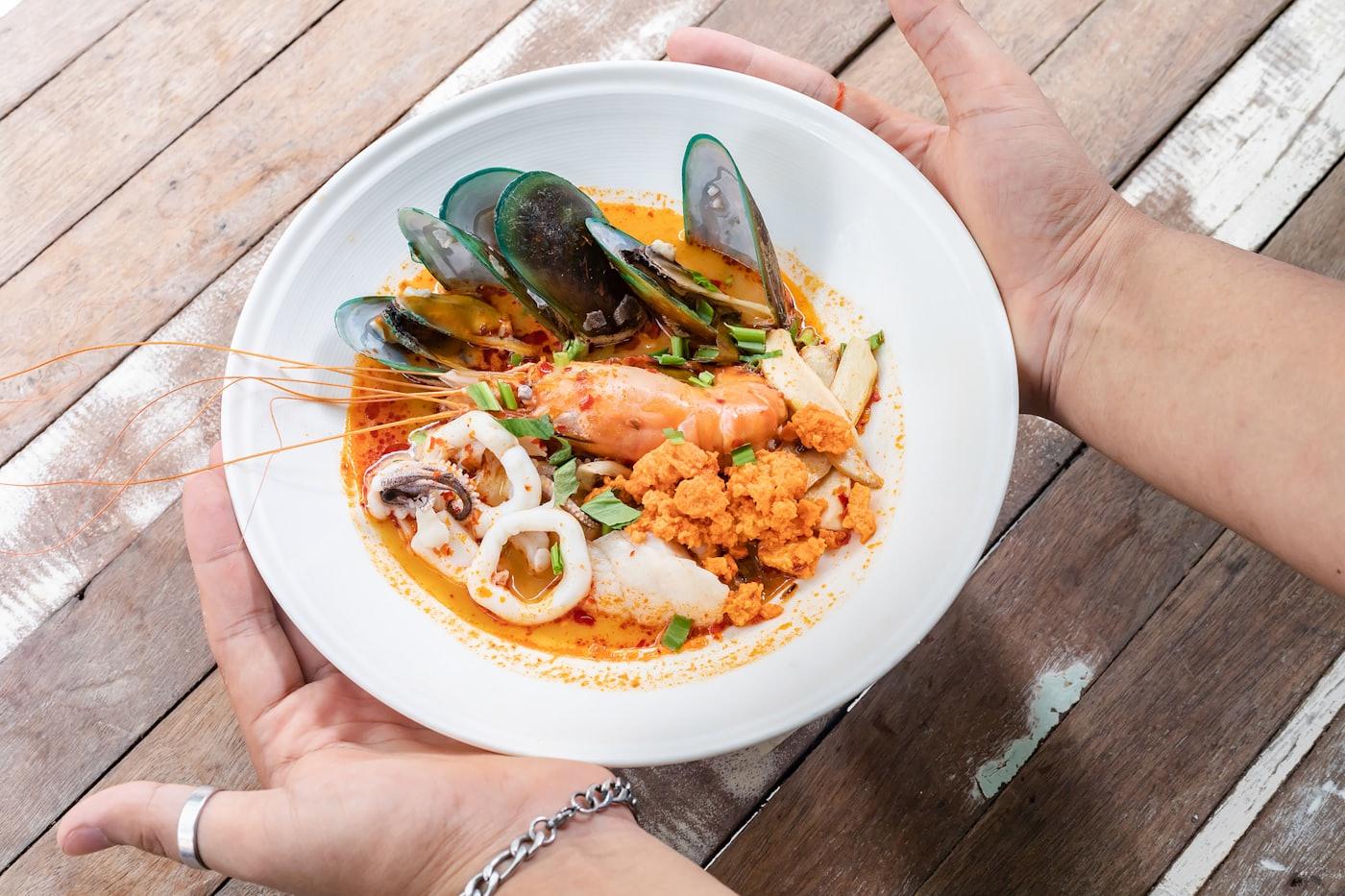
This love of freshness and sour-spicy accents links Vietnamese cooking to its regional neighbors. A similar play of acidity, heat and herbal aroma appears in Thai Tom Yum with Shrimp — another Southeast Asian soup where lime, chili and fresh leaves work together just as harmoniously as in pho.
Vietnamese coffee with condensed milk
It is impossible to wrap up a conversation about Vietnam without coffee — the country remains one of the world's largest producers of coffee beans, and it has developed a brewing culture all its own. Fresh milk kept poorly in the tropical climate, so the French brought in condensed milk, and the Vietnamese made it part of the ritual.
Classic ca phe sua (cà phê sữa) is made like this: a layer of sweet condensed milk goes into the bottom of a glass, and a small metal phin filter is set on top, loaded with coarsely ground dark coffee. Hot water passes slowly through the coffee and drips into the glass, drop by drop. The drink is then stirred and enjoyed either hot or over ice (ca phe sua da), which is especially welcome in the heat.
Egg coffee (ca phe trung) from Hanoi deserves a special mention: egg yolk whipped with condensed milk becomes an airy cream that sits on top of strong coffee like a dessert. It was invented in the mid-twentieth century, during years of milk shortage, and today it has become a local attraction.
Conclusion
Vietnamese cuisine rests on a few pillars: fresh herbs, fermented fish sauce, rice in all its forms and a constant play of contrasts. French influence added the baguette and coffee, but rather than dissolving the local character, it simply gave it new shapes.
The best way to understand this cuisine is to cook something yourself: simmer a clear broth for pho, roll a few goi cuon with a handful of fresh mint, or assemble a homemade bahn mi. And be sure to set a plate of herbs and a lime wedge beside it — so that the balance the whole thing was built around ends up in your own hands.