Food in video games stopped being a mere health bar to top up a long time ago. Today it is part of the world: the cake you assemble from eggs and sugar in Minecraft, the bowl of soup a neighbor gives you in Stardew Valley, or the steaming stew at a roadside tavern in The Witcher. We remember these dishes as vividly as plot twists, and one day we catch ourselves wondering: could you actually eat this?
It turns out you can — and often more easily than you would think. Virtual kitchens are inspired by real ones: developers take genuine recipes, simplify them down to a recognizable silhouette, and paint them in bright colors. Our job is to make the return trip: from pixels and polygons back to ingredients, grams, and oven temperatures.
In this guide we will walk through gaming's most iconic edible symbols — from a cubic cake to elven cooking — and sort out what is real and what is beautiful fiction. And wherever a dish can be recreated at home, we will point you to a ready recipe.
Minecraft Cake: a recipe hidden in the crafting grid
Minecraft is a game about blocks, and the food here is blocky too. The most famous example is the cake. To craft it, you place three buckets of milk, two pieces of sugar, one egg, and three sheaves of wheat on the workbench. In effect, the game spells out a real sponge cake recipe right in front of you: flour (wheat), sugar, eggs, and a dairy base.
This is a rare case where a virtual dish lines up almost literally with a real one. That makes it easy to recreate at home: a classic vanilla sponge, white icing on top, and berries standing in for the "red pixels" of the decoration. If you want to capture that signature cubic silhouette, bake the layer in a square pan, cover it with white cream, and arrange a tidy row of berries along the top.
We have put together a detailed step-by-step version made specifically for the game — take a look at Minecraft Cake: you will find the proportions, the assembly of a square cake, and a neat white "cap" topped with berries.
Stardew Valley: a farm kitchen in pixels
If Minecraft is about survival, Stardew Valley is about coziness. It is a farming game where you plant vegetables, catch fish, and cook in your own kitchen using recipes the townsfolk give you. There are over a hundred dishes, and nearly every one has a real-world counterpart: vegetable stew, fried fish, pancakes, pies.
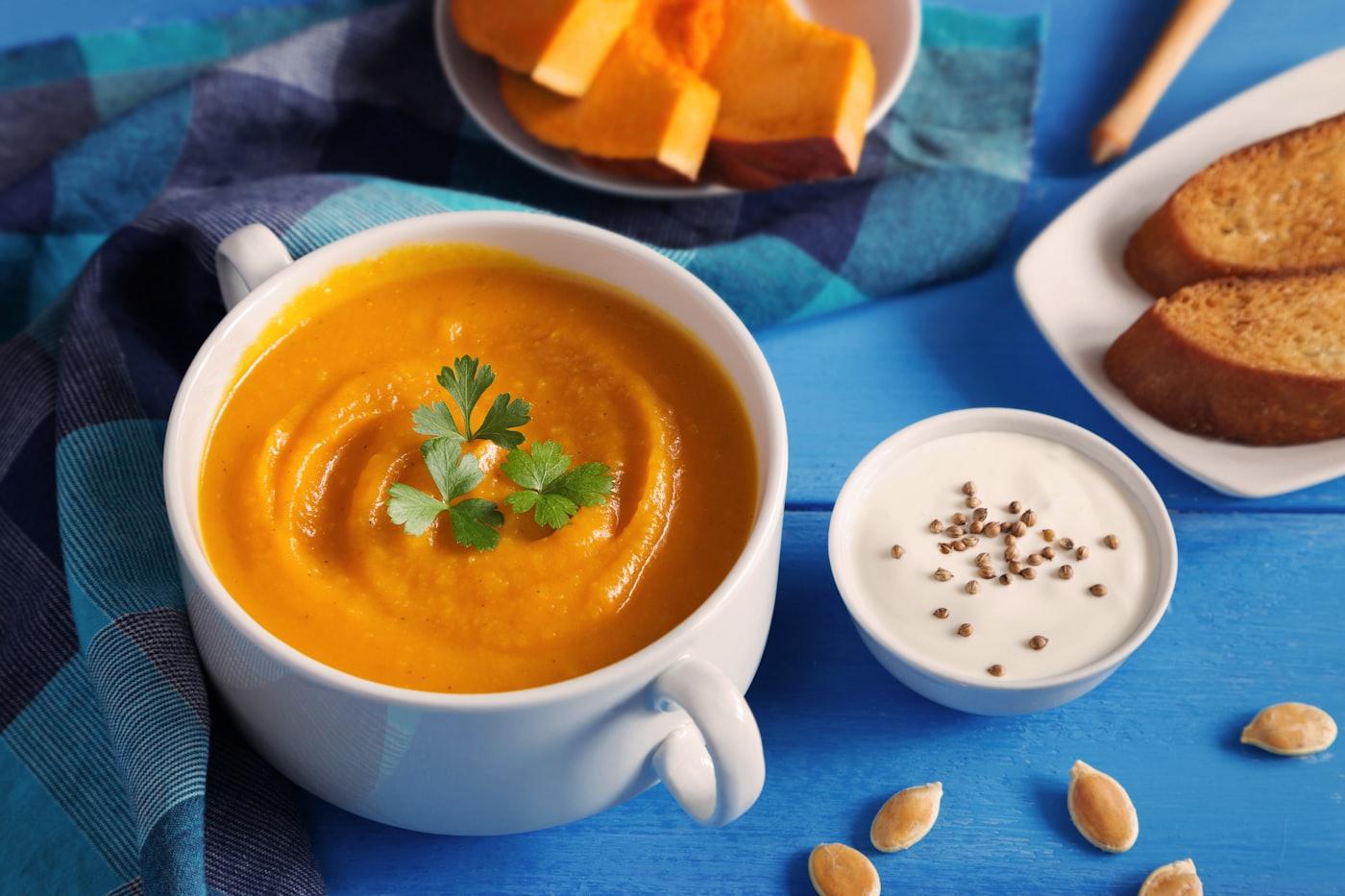
Players are especially fond of the autumn dishes. The pumpkin is one of the most valuable crops in Stardew Valley, so it is no surprise that pumpkin soup has become a hallmark of cozy in-game evenings. In reality this is a classic dish found around the world: the pumpkin is roasted or simmered, pureed, combined with onion, garlic, stock, and cream, then served with pumpkin seeds or croutons.
If you would like to bring that farm-fresh autumn to your own table, we have a velvety version: Stardew Valley Pumpkin Soup. It is an honest, genuine recipe that happens to match the pixelated picture from the game.
More Stardew dishes worth recreating
- Farmer's omelet — eggs, tomatoes, cheese; a simple farmer's breakfast.
- Vegetable stew — seasonal vegetables simmered in a single pot.
- Pumpkin pie — a dessert classic of American autumn.
- Hashbrowns — golden potato cakes to go with your morning coffee.
The key to Stardew Valley's cooking is that it is built on simple, accessible ingredients. This is not haute cuisine but home food — which is exactly why it is so satisfying to cook for real.
The Witcher's kitchen: gingerbread, stews, and a medieval table
The world of The Witcher is a Slavic and Central European Middle Ages, and the food fits: dense, filling, warming. In the games and books, Geralt regularly refuels in taverns on stews, roasts, bread, and cheese, while mead flows freely.
Gingerbread and honey sweets hold a special place. Honey gingerbread is an entirely real historical treat: built on honey, with spices like cinnamon, cloves, ginger, and nutmeg. Such gingerbread was baked for centuries across Eastern and Central Europe, and it fits perfectly into the atmosphere of the Witcher's fairs and inns.
We have recreated a fragrant, dense gingerbread in the spirit of Geralt's world — Geralt's Honey Gingerbread. It is based on a genuine historical technique: honey, rye or wheat flour, and a generous dose of spices. No invention here — only what was actually baked in the era that inspired the saga.
Stews and hot dishes
A pottage, or stew, is a catch-all term for thick peasant soups, and it shows up constantly in The Witcher. In reality it might have been a pea, cabbage, or grain stew with lard, root vegetables, and herbs. No exotic ingredients: medieval cooking was about what grows nearby and keeps well through winter. If you want to throw a "Witcher dinner," cook a thick pea soup with smoked meat and serve it with dark bread — the atmosphere will be more authentic than any costume.
Cooking in Zelda: Breath of the Wild: alchemy in a pot
In The Legend of Zelda: Breath of the Wild, cooking became a full-fledged game mechanic. Link tosses ingredients into a pot over a campfire, and dishes with effects are born: restoring health, protecting against cold, boosting stamina. This turns cooking into a small act of alchemy — you combine ingredients and see what comes out.
Many dishes here are fictional in name only but built on real logic. "Spicy meat and pepper stew" grants cold resistance — which echoes the genuine warming property of hot peppers. Fruit pies, rice balls (a clear nod to Japanese onigiri), baked apples — all of these have earthly counterparts.
The main culinary lesson of Zelda is simple: a good dish is a lucky combination of basic ingredients. Take meat, a vegetable, a spice, and a source of heat, and you are already on your way to dinner. In that sense the game honestly teaches the fundamentals of cooking, even if it is wrapped in fantasy.
Ramen and Asian food: from anime to game worlds
Ramen and Japanese food in games deserve their own chapter. A steaming bowl of noodles has become a visual cliche: it appears in fighting games, JRPGs, life simulators, and countless anime-styled games. Ramen works as a symbol of home warmth and a brief breather between battles.
And this is a case where the virtual dish is completely real. Ramen is genuine Japanese cuisine with a rich history: wheat noodles in a rich broth (pork, chicken, or miso based), with toppings like a marinated egg, chashu pork, bamboo shoots, and nori seaweed. That pink-and-white swirl on top of the noodles is kamaboko or narutomaki, a fish paste with its signature spiral.
If you have seen ramen in your favorite game and want to recreate it, keep a few things in mind:
- The broth is everything. It is simmered for hours to develop deep flavor.
- The noodles must be wheat-based, with a springy texture — not to be confused with rice noodles.
- Toppings make the dish: a soft-boiled egg, herbs, a slice of pork, a sheet of nori.
- Serve immediately — ramen does not wait, and the noodles soften quickly.
Even a simplified homemade version will capture the very coziness that games love to show.
Conclusion: pixels you want to taste
Video game food is a bridge between two pleasures: playing and eating. Behind the bright cubes and polygons there is almost always a real culinary tradition: the sponge cake in Minecraft, the pumpkin soup in Stardew Valley, the honey gingerbread in The Witcher, the Japanese ramen in dozens of anime games. The developers simply dressed up as artists and simplified what we already eat.
The best part is that this food can be brought back from the screen to the plate. Start with something simple: assemble a Minecraft Cake, cook a Stardew Valley Pumpkin Soup, or bake a Geralt's Honey Gingerbread. And from there, experiment like Link at a campfire: the best dish comes from a lucky combination.