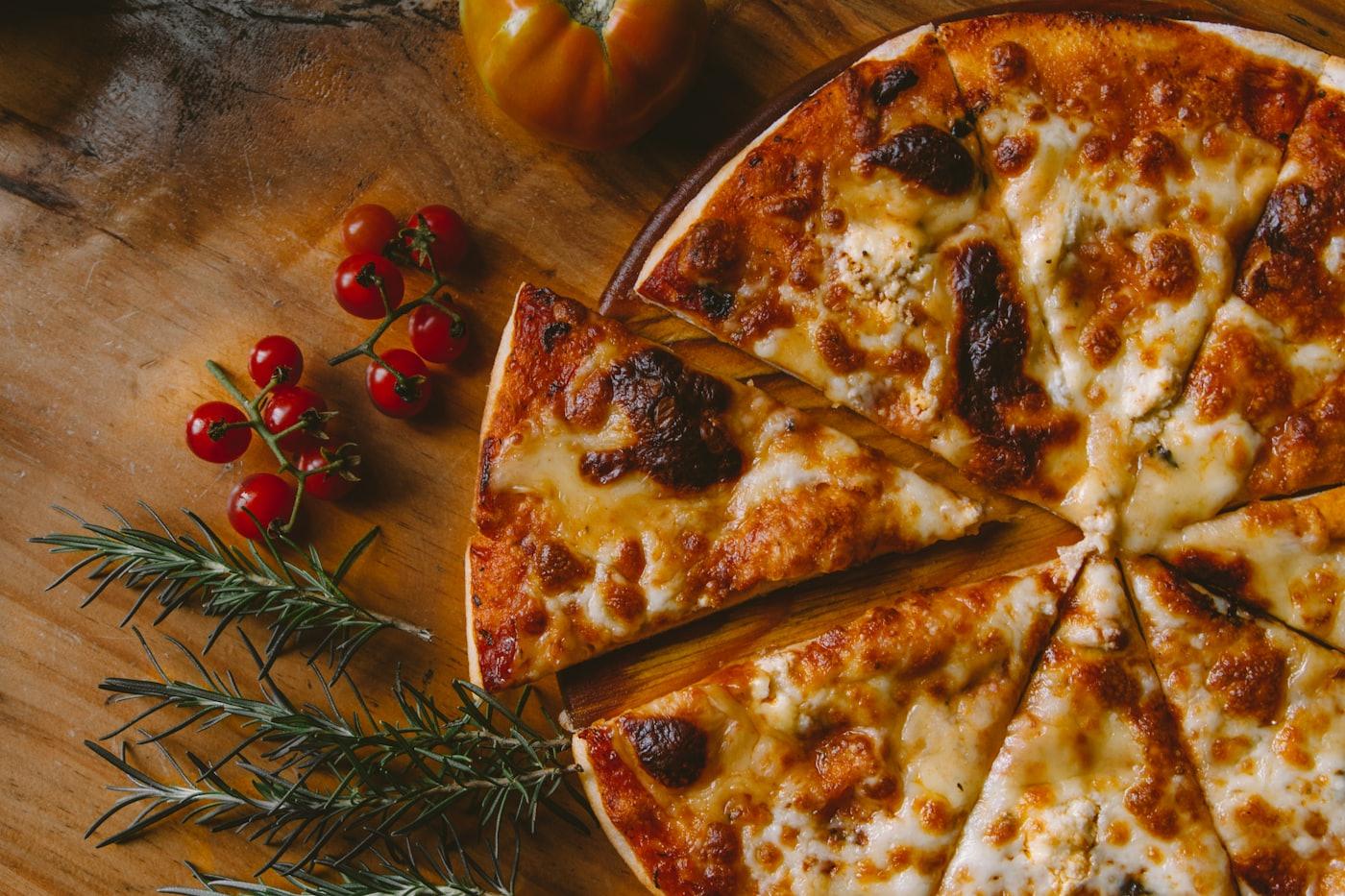
For most people, the word "pizza" conjures a single image: a round flatbread, melted cheese, tomatoes. But travel a couple of hundred kilometers across Italy and pizza transforms beyond recognition. In Naples it is soft and bubbles at the edges; in Rome it crunches like a cracker; in Sicily it resembles a fluffy savory pie; and in Chicago it becomes a deep dish with cheese hiding at the bottom.
What really sets all these versions apart is the dough and the way it is served. The toppings are often similar, but the thickness of the base, the proofing time, the oven temperature and the shape (round, rectangular, folded) turn one dish into a dozen distinct ones. Understanding these differences means you no longer just order "a pizza" — you choose exactly the style you are in the mood for.
In this article we will walk through the key types of pizza — from the classic Neapolitan to Roman, Sicilian, calzone and the American schools. And at the end we will return to the most recognizable of them all, the Margherita, which makes the perfect starting point for home experiments.
Neapolitan Pizza: the Protected Original
Neapolitan pizza (pizza napoletana) is the ancestor from which the others descend. Its identity is so strictly codified that it holds official TSG status (Traditional Specialty Guaranteed) at the EU level, while the Associazione Verace Pizza Napoletana sets rules down to the diameter.
The defining traits of Neapolitan pizza:
- Soft, long-proofed dough made from flour, water, salt and yeast — with no oil in the dough.
- A thin center and a tall, puffy rim (the cornicione), full of airy bubbles.
- A wood-fired oven at very high heat — around 430-485 °C, baking for just 60-90 seconds.
- Minimal toppings: tomatoes (classically San Marzano), mozzarella, basil, olive oil.
Because the bake is so short and fierce, the center stays moist and soft — so much so that Neapolitans often eat it with a knife and fork or fold it into a "wallet." That softness is not a flaw but a sign of correct technique. The two canonical versions are the Margherita (tomato, mozzarella, basil) and the Marinara (tomato, garlic, oregano, no cheese).
Roman Pizza: Thin and Crunchy
If Neapolitan is about softness and air, Roman is about crunch. There are two distinct Roman traditions here, and they are easy to confuse.
Pizza tonda romana — round and thin
The classic Roman round pizza is rolled out very thin across the entire surface, edges included. The dough often contains a little olive oil, which — together with a longer bake at a slightly lower temperature — produces a thin, brittle, almost cracker-like base (the scrocchiarella, literally "the crunchy one"). There is virtually no raised rim.
Pizza al taglio — pizza by the cut
The second Roman school is pizza al taglio, "pizza by the slice." It is baked in large rectangular trays, with a high-hydration dough that proofs for a long time, giving a light, large-holed crumb. The finished slab is cut with scissors into pieces, often priced by weight. This is a fast, street-food format — grab a piece and eat it on the go.
So "Roman pizza" can mean opposite textures: either the thin crunch of the round tonda or the airy rectangle of the al taglio. What unites them is their Roman origin and a love for a pronounced dough structure.
Sicilian Pizza: the Fluffy Rectangle
Sicilian pizza (sfincione) is in a completely different weight class. It is baked as a thick rectangle in an oiled pan, and the dough turns out tall and soft, almost like focaccia or an enriched bread. The name derives from a word meaning "sponge" — and the texture really is spongy and springy.
The classic Sicilian sfincione differs in its layering and ingredients: the dough is topped with a tomato-and-onion sauce, oregano, sometimes anchovies and breadcrumbs, while the cheese (often local caciocavallo) may hide beneath the sauce rather than sit on top. It is a hearty, aromatic, homely and generous pizza.
It was Sicilian immigrants who carried the thick rectangular dough format to the United States, where it became the local "Sicilian" pizza — also tall and square, but with the familiar American topping of mozzarella over the sauce.
Calzone: the Pizza That Got Folded
A calzone is essentially a pizza folded in half and sealed along the edge, forming a large crescent-shaped pocket. The name translates roughly as "trouser leg," and the shape really does resemble a rolled-up tube.
The main difference from a regular pizza is that the filling goes inside rather than on top. This changes the logic: the sauce and moist ingredients are sealed in, so the filling is often ricotta, mozzarella, ham or salami, sometimes with tomato. The closed shape traps steam, leaving the filling juicy, almost like a baked casserole.
The calzone also originates in Naples and was conceived as a convenient food "on the move" — the pizza was folded so it would be easier to carry and eat by hand. There is also a fried version (panzerotto, or calzone fritto): small deep-fried pockets that are especially popular as a street snack.
American Pizza: New York vs. Chicago
Arriving in the United States with Italian immigrants, pizza took on a life of its own and spawned several vivid regional styles. The two most famous — New York and Chicago — are built on fundamentally different principles.
New York style
New York-style is a large, thin pizza with a flexible yet sturdy base. The signature serving is a huge triangular slice folded lengthwise so it is easier to eat while walking. The dough is thin but not crisp like the Roman version: it is elastic, you can bend it, and the toppings still stay put. In essence it is a descendant of Neapolitan pizza, adapted to American ovens and lifestyles.
Chicago style (deep dish)
Chicago deep dish breaks every expectation. It is baked in a tall round pan like a pie: the dough climbs the walls, forming a rim several centimeters high. The order of layers is also inverted — cheese goes on the dough first, then the fillings, and the tomato sauce sits on top so it does not scorch during the long bake. The result is a massive, filling dish, eaten with a knife and fork, far closer to a casserole than to a typical flatbread.
There are other American schools too — for instance the rectangular Detroit-style pizza with its crispy, "caramelized" cheese edges — but it is the contrast between thin New York and thick Chicago that became the great symbol of just how far pizza can travel from the original.
What to Choose and Where to Start at Home
To sum up all the differences briefly:
- Thin and crunchy — Roman tonda.
- Thin but flexible — New York style.
- Soft and airy with a tall rim — Neapolitan.
- Fluffy and homely — Sicilian and pizza al taglio.
- Sealed and juicy — calzone.
- Maximally filling, like a pie — Chicago deep dish.
For a first attempt at home, almost everyone recommends starting with the Neapolitan Margherita: minimal ingredients, a clear flavor, and a dough on which it is easiest to learn the feel of proofing and baking. Once you have mastered the basics, you can move deliberately toward a thinner or, conversely, a fluffier version.
A ready recipe with dough ratios and detailed baking instructions is waiting for you here — Margherita Pizza. It is the very starting point from which it is convenient to try the rest of the pizza types on our list.
Conclusion
Pizza is not a single dish but an entire family, where dough and serving matter more than they seem. The same pairing of tomato and cheese turns into an airy Neapolitan flatbread, a crunchy Roman one, or a massive Chicago pie. Once you understand the logic of the dough — its thickness, hydration, baking temperature and shape — you stop being a hostage to the menu and start choosing consciously. And the best way to feel these differences in practice is to bake your own first Margherita and build from there.