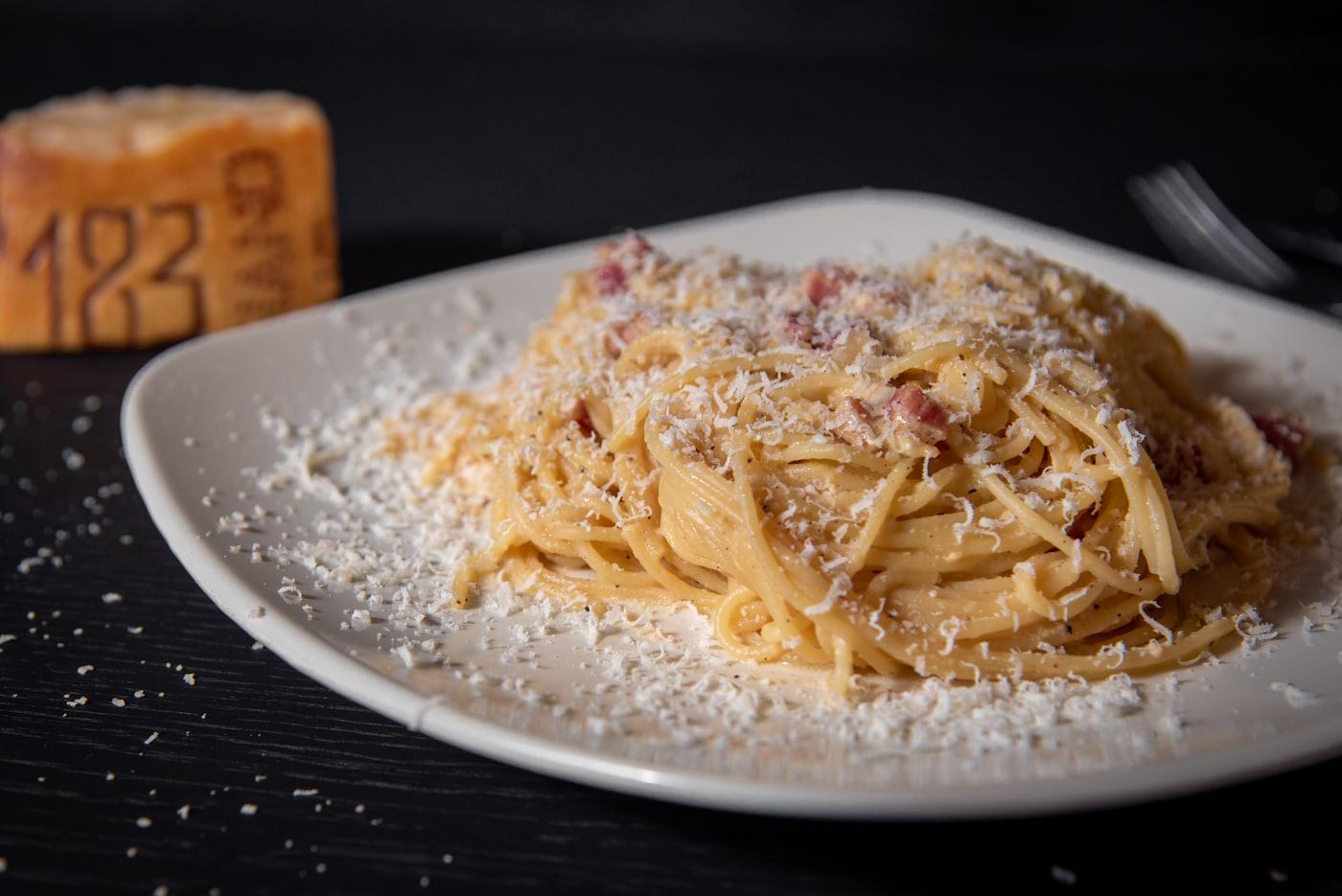
Italian cuisine boasts more than three hundred types of pasta, and that isn't a marketing gimmick or a quirk of tradition. Every shape was designed for a particular kind of sauce: some grab thick, meaty ragù with their ridges and tubes, while others slide elegantly through a light slick of garlic and oil. The moment you try to twirl spaghetti coated in a chunky stew that keeps sliding off the fork, you understand — shape matters just as much as the recipe.
In this guide we'll walk through the five most popular pasta types, the ones you can find in almost any supermarket: spaghetti, penne, farfalle, tagliatelle and ravioli. We'll cover where they come from, which sauces they're traditionally paired with, and why Italians take these combinations so seriously. We'll also explain the one golden rule of a real carbonara — the rule that still sparks heated debate in Italy.
The core idea is simple: there's no such thing as the "best" pasta, only the pasta that suits a particular sauce. Once you grasp this logic, you'll stop buying noodles at random and start building a dish on purpose — like an Italian grandmother, rather than a baffled tourist staring at the supermarket shelf.
Spaghetti: a classic that loves oil and the sea
Spaghetti is probably the most recognizable pasta in the world. These are long, thin strands with a round cross-section, and the name comes from the Italian spago — "string" or "twine." Spaghetti hails from southern Italy, above all Naples, where dried durum wheat pasta began to be produced industrially back in the 18th and 19th centuries.
The defining feature of spaghetti is its smooth surface and round shape. A strand like this can't hold on to heavy chunks of meat, but it works beautifully with oil- and tomato-based sauces that coat each strand evenly. Classic pairings include:
- Aglio e olio — garlic, olive oil and chili flakes. Minimalism at its finest.
- Pomodoro — a simple tomato sauce with fresh basil.
- Seafood — vongole (with clams) or shrimp pasta.
- Carbonara — yes, the classic carbonara is made precisely with spaghetti (or similar long shapes).
What you traditionally don't do with spaghetti is serve it with a thick meat-heavy bolognese. In Italy, bolognese is a sauce for wide, flat pasta, and "spaghetti bolognese" is widely seen as an invention that took root outside the country. A thin strand simply can't carry a heavy ragù: the meat ends up at the bottom of the bowl while the pasta goes its own way.
Penne: tubes for thick sauces
Penne is a short tube-shaped pasta with ends cut on the diagonal. The name translates as "quills": the slanted cut really does resemble the tip of an old-fashioned writing pen. Penne originated in northern Italy, in Liguria, at the end of the 19th century, when a machine for diagonal pasta cutting was invented.
The secret of penne lies in its hollow interior and often ridged surface (the penne rigate variety). The tubes scoop sauce up inside, while the grooves on the walls catch it on the outside. That's why penne are perfect for anything thick and rich:
- Arrabbiata — a spicy tomato sauce with garlic and chili.
- Cream sauces — for instance, with salmon or mushrooms.
- Baked pasta — the pasta is baked in the oven with cheese and sauce.
- Pesto — the short shape holds the fragrant green basil paste well.
It's precisely this ability to "hide" sauce inside that makes penne a favorite of student kitchens and family casseroles: every piece comes out evenly soaked.
Farfalle: bow ties for light, bright sauces
Farfalle is Italian for "butterflies" (in English-speaking countries they're sometimes called "bow ties"). These are flat squares of dough pinched in the middle to create little wings and a denser center. Farfalle come from northern Italy, the regions of Emilia-Romagna and Lombardy.
Farfalle have an interesting double texture: the thin edges cook faster and stay tender, while the dense center has a bit more bite. Because of this shape, farfalle are rarely served with very heavy sauces — a thick ragù would just slide off the smooth wings. They are, however, magnificent in:
- Cold pasta salads — farfalle hold their shape and look beautiful.
- Light cream and vegetable sauces — with peas, asparagus or ham.
- Olive-oil-based sauces — with sun-dried tomatoes and cheese.
Farfalle are all about aesthetics and lightness. If you need a dish that looks equally good served hot or in a cold picnic salad, the bow ties won't let you down.
Tagliatelle: ribbons from the north for rich ragù
Tagliatelle are long, flat noodles about 6–8 mm wide, traditionally made from egg dough. They are the pride of Emilia-Romagna, and of Bologna in particular. There's a charming legend that tagliatelle were invented by a chef inspired by the golden curls of Lucrezia Borgia, but historians are skeptical — it's more likely a later piece of folklore than a documented fact.
One thing, however, is certain: it's tagliatelle (not spaghetti) that Bologna serves with the famous ragù alla bolognese. The wide, rough egg-dough ribbon holds thick meat sauce perfectly — it practically settles onto the surface of the pasta instead of sliding off. Tagliatelle are served with:
- Ragù alla bolognese — the canonical pairing, even recorded in the official recipe filed with Bologna's chamber of commerce.
- Cream sauces with mushrooms — especially porcini in the autumn.
- A prosciutto and cream sauce — a simple but rich option.
If you've come across "fettuccine," it's a close cousin of tagliatelle, slightly wider and more popular in the United States (think fettuccine alfredo, which, incidentally, is barely known in Italy itself in its familiar American form).
Ravioli: filled pasta
Ravioli stand apart: this is not just a shape but a stuffed pasta. Two layers of thin dough with a filling sandwiched inside, pinched shut around the edges. It's one of the oldest types of filled pasta in Italy — references appear as far back as 14th-century medieval texts.
The filling can be almost anything: ricotta and spinach, meat, pumpkin, mushrooms, even pear with cheese. Since the main flavor is already tucked inside, the sauce for ravioli should be delicate, so it doesn't overwhelm the filling:
- Melted butter with sage — a classic for pumpkin and cheese ravioli.
- A light tomato sauce — for meat fillings.
- Just butter and parmesan — when the filling is expressive enough on its own.
Close relatives of ravioli are tortellini and tortelloni — the same filled "parcels" in a different shape. This is the territory of handmade pasta and the festive table: shaping them takes time, but the result is worth it.
The carbonara rule: four ingredients and not a drop of cream
Carbonara is a great example of how shape and technique work together. The classic Roman recipe calls for just four ingredients: guanciale (cured pork cheek), eggs (often just the yolks), pecorino romano cheese and black pepper. And — pay attention — no cream whatsoever.
That's the golden rule of carbonara: the creaminess of the sauce comes not from cream but from an emulsion of egg yolks, cheese and hot starchy pasta water. In Italy, cream is considered a crude shortcut that kills the dish's finesse. The second crucial point is that the sauce must not be cooked: the eggs are mixed with the nearly-done pasta away from high heat, otherwise instead of a silky cream you'll get scrambled eggs.
Traditionally carbonara is made with spaghetti or rigatoni. Want to test the rule in practice? Take a look at our detailed Pasta Carbonara recipe — it walks you through, step by step, how to achieve that silky sauce without a single drop of cream.
How to match pasta to sauce: a quick cheat sheet
If you boil all this logic down to a single principle, it goes like this: the thicker and heavier the sauce, the more textured and wider the pasta should be. And vice versa — light oil and tomato sauces are friends with thin, smooth shapes.
- Light oil, garlic, seafood — spaghetti and long thin shapes.
- Thick, spicy, creamy sauces and bakes — penne and other tubes.
- Salads and light vegetable sauces — farfalle.
- Rich meat ragù — tagliatelle and wide ribbons.
- Delicate sauces over a filling — ravioli and stuffed pasta.
Italian pasta isn't about complexity; it's about common sense and respect for the ingredients. Once you understand why bolognese lives on tagliatelle and why carbonara won't tolerate cream, your cooking takes on a whole new dimension. Start small — cook a real Pasta Carbonara, feel the difference, and then experiment boldly: now you have the map.