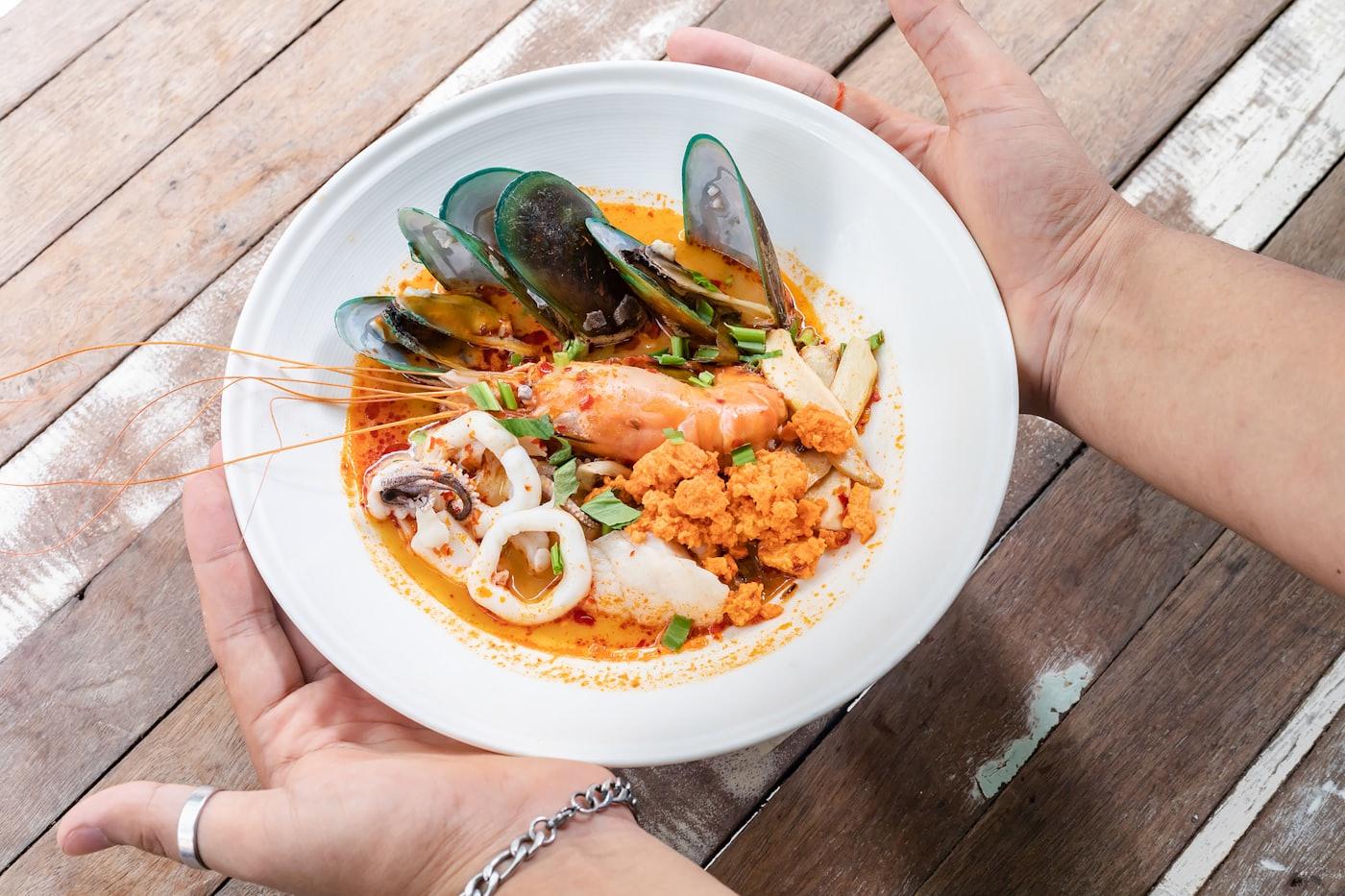
Thai cuisine is often described with a single word: explosion. The first spoonful of tom yum hits you with heat, then the lime kicks in with a sharp sourness, followed by the salty depth of fish sauce, while somewhere in the background the gentle sweetness of palm sugar lingers. All of this happens within a single second, and that density of sensation is exactly what defines Thai cooking.
Unlike many European traditions, where a dish is built around one leading flavor, Thai cuisine deliberately brings opposites together. There is no choosing between sour and sweet here. You take both, add spicy and salty, and make them sound at once, like a chord. A good Thai cook is, above all, a tuner of balance.
This article is about the logic behind Thai flavor: which five dimensions form its foundation, which ingredients create them, and how it all comes together in famous dishes like tom yum, pad thai, and curry. At the end, we'll point you toward the recipe that makes the easiest entry point into this cuisine.
Five Flavors as a Philosophy, Not Chemistry
Classic Thai cuisine works with five core flavors: sour, sweet, salty, spicy, and umami (a savory, meaty depth). It's worth noting that Thai cooks don't treat heat as a separate scientific taste in the strict sense, since spiciness is created not by taste receptors but by the irritation of capsaicin. Yet in the Thai culinary worldview, heat is a full member of the ensemble, and a dish without it is considered incomplete.
The main principle is simple: no single flavor should overpower the others. If a curry turns out too sweet, it's balanced with fish sauce and lime juice. If a soup comes out too sour, a touch of sugar is added. Thai cooking is constant adjustment, tasting, and fine-tuning. A recipe here is more of a guideline than a law, and the cook calibrates the final flavor by tongue.
This philosophy is rooted in ideas of harmony and moderation common across Southeast Asia. Balanced food is believed to be not only tastier but also healthier, bringing the body into equilibrium. That's why even a bowl of street noodles costing a couple of dollars follows the same principle as a dish in an expensive restaurant: the flavors must hold each other in balance.
The Ingredients That Create the Thai Character
Behind Thailand's recognizable taste lies a compact but powerful set of ingredients. Without them, a dish may be delicious, but it won't be Thai.
- Lemongrass — tough, fragrant stalks with a citrusy, grassy aroma. They are bruised and added to soups and curries to release their scent, though the stalk itself is not eaten.
- Galangal — a root that looks like ginger but has a sharper, resinous, almost pine-like and citrusy flavor. Substituting plain ginger is a last resort only, since the profile changes entirely.
- Kaffir lime leaves — glossy double leaves with an intense citrus aroma. They are torn or finely sliced and added to soups, curries, and salads.
- Fish sauce (nam pla) — a fermented sauce made from anchovies and salt, the main source of saltiness and umami. It is this, rather than ordinary salt, that gives Thai dishes their distinctive depth.
- Palm sugar — a soft, caramel sweetness that rounds out the spicy and sour notes.
- Chili and lime juice — the spicy and the sour, two electric flavors that Thai cooks like to keep vivid.
These five or six ingredients are a kind of alphabet. From their combinations and proportions emerge dozens of completely different dishes.
Tom Yum and Tom Kha: Two Faces of Thai Soup
Tom yum is perhaps the most famous Thai soup and a perfect illustration of the five-flavor balance. In a single bowl, fiery chili meets the sourness of lime, the saltiness of fish sauce, and an aromatic foundation of lemongrass, galangal, and kaffir lime leaves. It's most often made with shrimp (tom yum kung), and less commonly with chicken or mushrooms. The famous rich, red-orange version gets its color and creaminess from nam prik pao paste and a little coconut milk, while the clear version (tom yum nam sai) stays light and sharper.
If you want to experience this cuisine in practice, a soup is the best place to start. Take a look at our Tom Yum with Shrimp recipe, a convenient starting point where you can see all five flavors come together into one chord.
Tom kha is the milder, more enveloping relative of tom yum. Its base is coconut milk, which makes the soup creamy, with muted heat and a pronounced sweetness. Tom kha is most often made with chicken (tom kha kai). The lemongrass, galangal, and kaffir lime are the same, but the coconut softens them, turning the searing character of tom yum into something velvety and warming. These two soups are a great way to understand how the same set of aromatics can sound completely different depending on what you do with heat and richness.
Pad Thai: Street Classic with a History
Pad thai is a stir-fried rice noodle dish that today is considered almost the chief culinary symbol of Thailand. Curiously, the dish is relatively young: it became popular in the mid-twentieth century during an era of national modernization, when authorities promoted rice noodles as affordable and patriotic food. That's how a street dish became part of national identity.
The flavor balance of pad thai rests on a sauce of tamarind (sour), palm sugar (sweet), and fish sauce (salty and umami). In the wok, the noodles are joined by tofu or shrimp, egg, bean sprouts, and garlic. Pad thai is served with lime wedges, crushed roasted peanuts, and chili flakes, so each diner adds heat and acidity to taste right at the table. This is the Thai culture of balance in action: the final tuning of flavor is entrusted to the eater.
Thai Curries: A Color Palette of Flavors
In Thailand, curry is not a powder, as in the Indian tradition, but a paste of fresh ingredients ground together. The base is chili, garlic, lemongrass, galangal, kaffir lime, shrimp paste, and spices. The finished curry is almost always simmered in coconut milk, which softens the heat and binds the flavors.
Thai curries are commonly distinguished by color:
- Green curry (kaeng khiao wan) — the spiciest of the common ones, owing its color to fresh green chili and an abundance of herbs. Despite the heat, its name includes wan, meaning sweet, which precisely reflects its balance.
- Red curry (kaeng phet) — made with dried red chili, a little milder than green and very aromatic.
- Yellow curry (kaeng kari) — the mildest, with turmeric and notes that clearly echo Indian and Malay cuisine, reflecting the trade connections of southern Thailand.
The same logic works in each of them: spicy chili, salty fish sauce, the sweetness of sugar and coconut, the tang of lime, and the depth of shrimp paste. The accents shift, but the principle stays the same.
How to Start Cooking Thai at Home
The beginner's main fear is that nothing will work without rare ingredients. In reality, a basic Thai kit is now available almost everywhere: fish sauce, coconut milk, curry paste, and lime juice are already half the battle. Lemongrass, galangal, and kaffir lime leaves are increasingly found fresh or frozen, and if not, many stores offer ready-made tom yum kits.
A few practical pointers:
- Start with a soup: it's the easiest place to feel and correct the flavor balance.
- Add fish sauce and sugar little by little, tasting constantly.
- Add lime juice at the very end, since prolonged boiling drives off its freshness.
- Adjust the heat to your taste: authentic Thai food doesn't have to burn.
The best way to understand the Thai philosophy of flavor is to cook at least one dish with your own hands. So we suggest moving on to the Tom Yum with Shrimp recipe and assembling your first chord of five flavors.
Conclusion
Thai cuisine teaches an important principle that reaches far beyond the stove: harmony is born not from a single dominant voice but from a dialogue of opposites. Sour and sweet, spicy and salty, the depth of umami — every flavor is needed to make the others ring more brightly. Tom yum, tom kha, pad thai, and the colorful curries are simply different ways of assembling the very same balance. Once you grasp this logic, you'll stop cooking by the book and start truly feeling the dish. And the easiest place to begin is a fragrant bowl of tom yum.