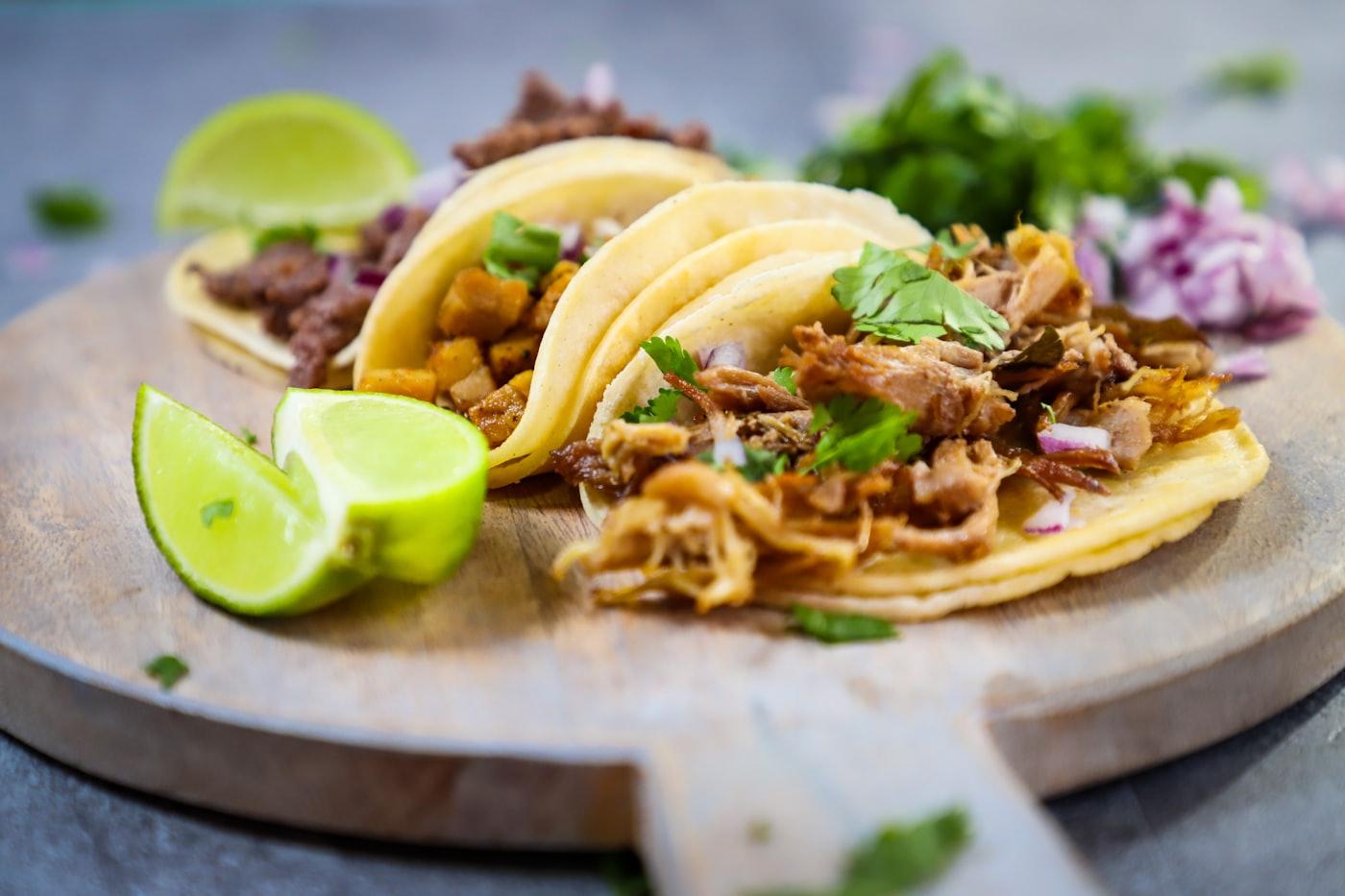
If Mexico City's street food had an anthem, it would surely play to the spin of a vertical spit piled high with marinated pork and crowned by a golden pineapple. Tacos al pastor are far more than a popular snack — they are a true culinary symbol of the Mexican capital, a dish where two very distant cooking traditions came together.
The most surprising thing about this taco is that its roots don't trace back to Aztec markets at all, but to the Middle East. The story of tacos al pastor is a story of migration, adaptation, and how a borrowed recipe can become more local than the locals themselves. In this article we'll unpack where the famous spit came from, why the pork is marinated in a red achiote paste, and how to make authentic al pastor in your own kitchen without any special equipment.
And if you can't wait to get cooking, jump straight to our step-by-step Tacos al Pastor recipe — but first, a bit of context that will make the whole process far more rewarding.
The Lebanese Connection: What Does Shawarma Have to Do With It
In the late 19th and early 20th centuries, Mexico welcomed a wave of immigrants from what is now Lebanon and Syria, many fleeing the Ottoman Empire. They brought with them the tradition of shawarma — meat that is marinated, stacked in layers on a vertical spit, and slow-roasted, with the browned edges shaved off as it cooks.
At first, these immigrants prepared the dish the Middle Eastern way: with lamb, pita-style flatbread, and familiar spices. That's how "tacos árabes" — Arab tacos — appeared in Mexico, especially in the city of Puebla, where they are still served on a wheat flatbread resembling pita. This was the transitional form, the direct ancestor of the dish we know today.
Over time, Mexican cooks reimagined the borrowed idea to suit local tastes. Lamb, which was never an everyday meat in the country, gave way to pork. The wheat flatbread was swapped for the classic corn tortilla. And the Middle Eastern spice blend was traded for a local marinade built on dried chiles and achiote paste. By roughly the middle of the 20th century, what we now call tacos al pastor was born.
What "Al Pastor" Actually Means
The name "al pastor" translates from Spanish as "shepherd style" or "in the manner of the shepherd." It nods to the method of cooking meat on a spit, long associated with grilling lamb over open fire while herding — yet another wink toward those Middle Eastern origins. The vertical spit itself is called a "trompo" in Mexico, meaning "spinning top," a reference to the cone-like shape of the layered, rotating meat.
The Marinade: Achiote, Chiles, and the Magic of Red
The instantly recognizable brick-red color of al pastor doesn't come from tomatoes, as many assume. Two ingredients do the heavy lifting: achiote and dried chiles.
Achiote (also known as annatto) is the seed of the annatto tree, used by the peoples of Mesoamerica for centuries both as a dye and as a seasoning. It lends a deep red-orange hue and a gentle, earthy, faintly peppery aroma. You'll most often find achiote sold as a pressed paste called "recado rojo," already blended with spices and vinegar.
The second pillar of the marinade is dried Mexican chiles. The most common are:
- Guajillo chiles — they give a rich color and a light berry-like tang without much heat;
- Ancho chiles — dried poblano peppers, sweet, with notes of prune and cocoa;
- Pasilla or morita chiles — added for smokiness and deeper heat, to taste.
To this base cooks add garlic, cumin, oregano, clove, white vinegar, and — crucially — a splash of pineapple juice, which not only adds sweetness but also carries bromelain, an enzyme that helps tenderize the meat. Pork (usually shoulder or collar) is sliced thin, coated in the marinade, and left for at least a few hours — ideally overnight.
Pineapple, Onion, and Cilantro: The Signature Finish
No true al pastor is complete without its trio of accompaniments. A whole pineapple is skewered onto the top of the trompo, and as the spit turns, its juices run down over the meat while charred slices are carved off alongside the pork. The sweetness of the caramelized pineapple plays against the spiced meat and the acidity of the marinade — and it's exactly this balance that makes the dish so addictive.
A classic tacos al pastor build looks like this:
- A small warm corn tortilla (often doubled up for strength);
- A mound of finely chopped roasted meat;
- Pieces of charred pineapple;
- A generous scatter of finely diced white onion and fresh cilantro;
- A wedge of lime and a splash of hot salsa to taste.
No cheese, no sour cream, no heavy sauces — authentic al pastor is minimalist, resting on the quality of the meat and the freshness of the herbs. That restraint is part of its charm.
How to Make Tacos al Pastor at Home Without a Spit
The main obstacle to cooking this at home is the absence of a trompo. The good news is that the heart of the dish lies not in the equipment but in the marinade and the contrast of textures. Recreating al pastor at home is entirely doable, and there are a few proven approaches.
Skillet or Grill
The simplest route. Marinated pork, sliced thin, is seared in batches on a well-heated skillet (cast iron is ideal) or on the grill, without crowding the surface, so the meat browns rather than steams. Once cooked, the meat is chopped into small pieces — that's how you get those signature crispy edges.
Oven With a Mock Spit
If you want to get closer to the original, stack the marinated slices tightly, run skewers through them or mount them on a vertical support, and roast in the oven, shaving off the browned outer layers as you go. This is the closest you'll come to a real trompo at home.
Key Home Cooking Tips
- Don't skip the marinade. A minimum of 4 hours, ideally an overnight rest in the fridge. This is where the flavor is built.
- Char the pineapple separately. Caramelize the slices in a dry skillet or on the grill until the edges turn golden to bring out their sweetness.
- Warm your tortillas. A couple of seconds per side in a dry pan makes them soft and fragrant; never serve them cold.
- Chop the meat fine. After searing, a few passes with a knife turn the slices into the right texture for tacos.
- Serve immediately. Al pastor is food for the moment: hot meat, fresh onion and cilantro, a squeeze of lime.
We've collected the exact marinade proportions, precise searing times, and the assembly order in a dedicated step-by-step Tacos al Pastor recipe — open it alongside this article and cook along.
Conclusion
Tacos al pastor are a beautiful example of how cooking erases borders. The Middle Eastern vertical spit met Mexican chiles, achiote, and tropical pineapple, and the result is a dish impossible to imagine apart from Mexico City. Behind its street-food simplicity lies a whole history of migration and cultural cross-pollination.
The best part is that you don't need to fly to Mexico or own a bulky trompo to taste that history. A good marinade, a ripe pineapple, warm tortillas, and a little enthusiasm are enough. Make al pastor at home just once and you'll understand why Mexicans are happy to line up for them every single evening.