Lebanese cuisine is arguably the most recognizable face of all Eastern Mediterranean cooking. Wherever you live, there is almost certainly a spot nearby serving hummus, falafel and shawarma — and very often the menu uses Lebanese names. The reason is simple: throughout the twentieth century, Lebanese people emigrated all over the world — to the United States, France, Brazil, West Africa, the Gulf — and they carried the recipes of their home table with them.
But the popularity of a few dishes is only the tip of the iceberg. Real Lebanese cooking rests on three pillars: generosity, freshness and togetherness. The table here is not strictly divided into starters and mains. Instead, a multitude of small plates appears in the center, to be shared slowly and without hurry. This format is called mezze, and it defines the entire philosophy of Lebanese food.
Geographically, Lebanon is a narrow strip between the mountains and the Mediterranean, with a mild climate, olive groves, lemon trees and an abundance of herbs. Hence the brightness of its flavors: olive oil, lemon juice, garlic, parsley, mint, sesame paste (tahini) and spices like sumac and za'atar. And hence, too, a surprising thread that runs from Lebanese shawarma all the way to Mexican street tacos. But first things first.
Hummus: more than a dip
Hummus (more precisely hummus bi tahina, "chickpeas with tahini") long ago became a global product sold in plastic tubs at the supermarket. That is a bit of a shame, because real hummus is an exquisitely smooth purée, ideally eaten warm and freshly made.
The classic recipe is honest and simple:
- boiled chickpeas;
- tahini — a paste of ground sesame seeds;
- freshly squeezed lemon juice;
- garlic;
- salt and a little iced water for an airy texture.
The secret to its silkiness lies in the details: the chickpeas are cooked until completely soft (often with a pinch of baking soda so the skins slip off), then blended for a long time with added water. Hummus is served in a shallow dish, swirled into its signature "wave" with the back of a spoon, drizzled with olive oil, dusted with paprika or sumac, and scooped up with warm pita bread.
It is worth understanding that hummus is not the invention of a single country. Lebanon and several neighboring states all lay claim to it, and this is a long-running culinary argument. The honest answer: dishes of chickpeas and sesame have existed across the Middle East for centuries, and hummus is shared heritage rather than anyone's monopoly.
Falafel: crispy fritters born from a debate
Falafel is deep-fried balls or patties made from a paste of ground legumes. In Lebanon and most of the Levant they are made from chickpeas, whereas Egypt more often uses fava beans (where the dish is called ta'amiya). Arguments over falafel's exact origin have raged for decades, and there is no clear winner — yet another example of a shared regional kitchen.
What makes falafel so good:
- soaked (but never boiled!) chickpeas are ground raw — the key to a crumbly rather than gummy texture;
- parsley, cilantro, garlic, onion and spices like cumin and coriander go into the mix;
- sometimes so much fresh herb is folded in that the inside turns emerald green.
The classic street version is falafel tucked into a pita pocket with vegetables, pink pickled turnips and tahini sauce. It is filling, fully plant-based food, which largely explains falafel's worldwide popularity among vegetarians.
Tabbouleh and other salads
If hummus is about creamy softness, tabbouleh is about freshness and crunch. And here is an important correction for anyone who has tried "tabbouleh" in European cafés: real Lebanese tabbouleh is first and foremost a parsley salad, not a grain salad.
The base is finely chopped flat-leaf parsley, joined by a little bulgur (parboiled cracked wheat), tomatoes, scallions and mint. The dressing is simple: olive oil, lemon juice, salt. Bulgur plays the role of an accent, not the star — in a proper tabbouleh there is far more greenery than grain.
There are almost always other salads on the table too — fattoush, for instance, with toasted pita shards and tangy sumac. They all serve one purpose: to bring lightness and acidity to the richer dishes around them.
Mezze: the art of the shared table
Mezze (or mazza) is not a single dish but an entire format of dining. Dozens of small plates are spread out: hummus, falafel, tabbouleh, baba ghanoush (a purée of roasted eggplant with tahini), kibbeh (bulgur-and-meat croquettes), stuffed vine leaves, pickled vegetables, olives, cheese and fresh flatbreads. All of it is eaten slowly, with conversation, plates passed around the table.
The central idea of mezze is not to fill up but to connect. The meal stretches over hours, and the food itself becomes a reason to gather. In this, Lebanese cuisine is very close to Spanish tapas or Italian antipasto: small portions, a variety of flavors, an emphasis on sharing. For a hospitable Lebanese home, a table groaning under the weight of plates is a form of care and respect for the guest.
It is precisely out of this mezze culture that a love of skewered meat grows — and that brings us to the most fascinating part of the story.
Shawarma and an unexpected relative in Mexico
Shawarma is meat slowly roasted on a vertical rotating spit and shaved off in thin slices as it cooks. In Lebanon it is wrapped in a thin flatbread with vegetables and sauces — toum (garlic) or tahini.
The very idea of the vertical grill comes from the Middle East: Turkish döner, Greek gyros, Arabic shawarma — these are related dishes of one tradition. And this is where it gets interesting.
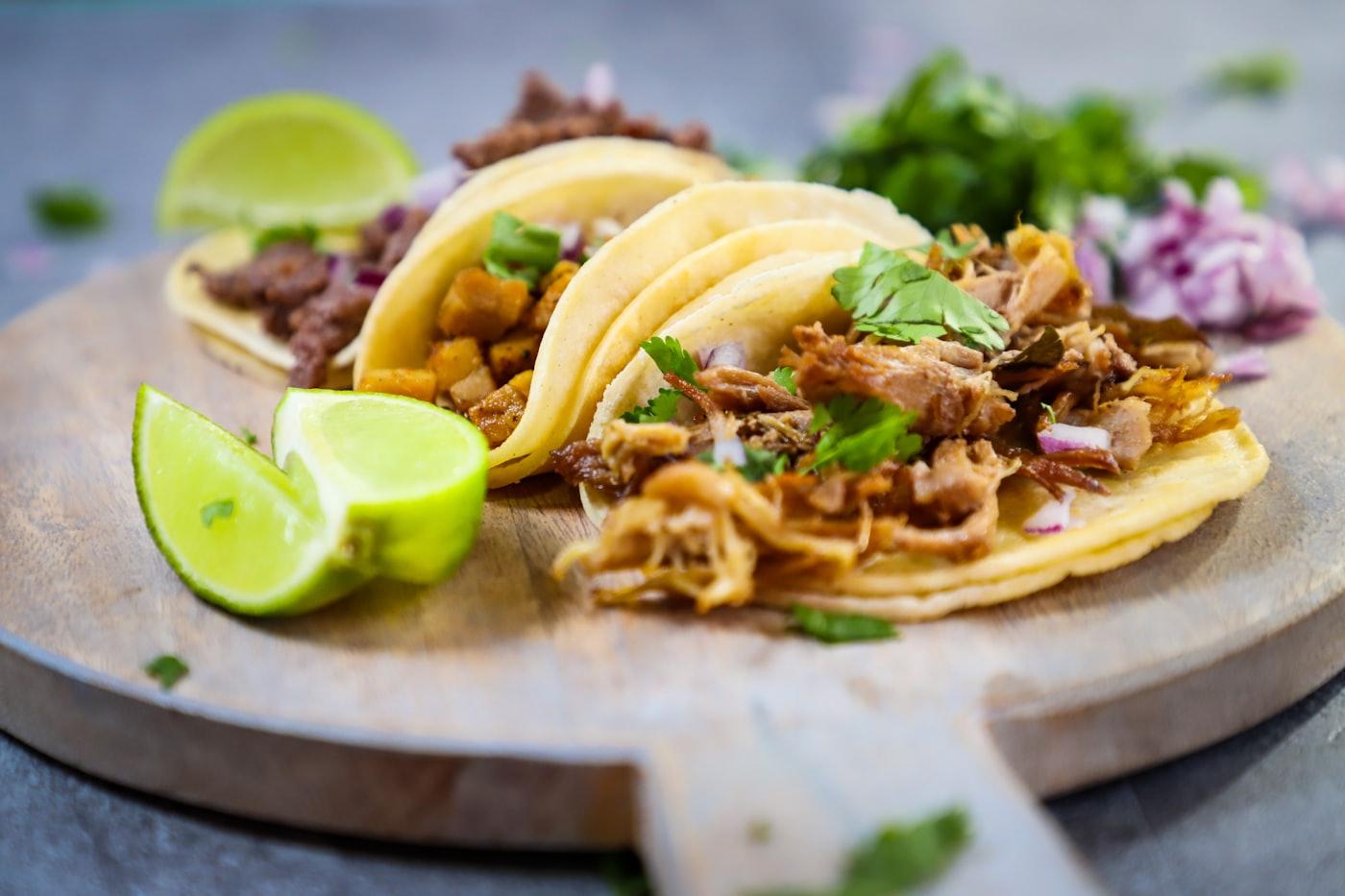
In the late nineteenth and early twentieth centuries, Lebanese emigrants arrived in Mexico, bringing the vertical-spit shawarma with them. Over time, local cooks adapted the technique to Mexican tastes: instead of lamb they used pork, marinated it in achiote (annatto) and dried chilies, and crowned the spit with a pineapple. Thus was born one of Mexico's most famous street foods — Tacos al Pastor. The word "pastor" ("shepherd") itself nods to the shepherding tradition of roasting meat, and the spit (called a trompo, "spinning top," in Spanish) is a direct descendant of Middle Eastern shawarma.
The result is a beautiful culinary loop: Lebanese shawarma, having crossed an ocean, turned into a Mexican street food now known around the world. If you try both Lebanese shawarma and Tacos al Pastor, you will literally taste two ends of the same story — the shared principle of the vertical grill, expressed differently by two cultures.
How to build a Lebanese table at home
The good news: to throw a mini-mezze, you do not need a restaurant. Three or four dishes and the right mindset will do:
- Make warm hummus as your foundation.
- Add fresh tabbouleh for contrast.
- Fry some falafel or marinate meat for shawarma.
- Don't forget pita bread, olive oil and lemon wedges.
And most importantly — put everything in the center of the table and eat together, without rushing. That is the very essence of Lebanese cuisine.
Lebanese food is deceptively simple: chickpeas, sesame, herbs, lemon, olive oil. Yet from these humble ingredients comes a cuisine beloved on every continent — and one, it turns out, invisibly linked even to Mexican tacos. It is the best reminder that food knows no borders: it travels with people and is reborn anew each time.