Some games you play for the action. Stardew Valley is the other kind — a pixel farm you return to in order to exhale. You inherit your grandfather's overgrown plot, fix up the coop, plant pumpkins for autumn, and one morning you realize that cooking has stopped being a health bar and become a small ritual. A fried egg before heading into the mines, pumpkin soup for the Harvest festival, cookies as a gift for a neighbor — food in this game is tied to seasons, relationships, and your own garden.
That farm-to-table philosophy isn't something developer Eric Barone invented. Real farmers lived this way for centuries: they cooked from what grew nearby and wasted nothing. That's exactly why Stardew Valley's dishes are so easy to recreate — behind each one is an ordinary country kitchen with no rare ingredients.
Below we'll look at how cooking actually works in the game, then walk through five of its homiest recipes: what they do for your character on screen, and how to make them on your own stove.
How cooking works in the game
You can't cook in Stardew Valley right away. First you need a kitchen, which appears after the first house upgrade from Robin the carpenter. Until then you're stuck with raw produce and the occasional festival dish.
Every recipe restores energy and health, and some grant temporary buffs — to fishing, speed, or defense. Recipes unlock in three ways:
- Skill levels. Level up farming, fishing or mining and new recipes appear automatically.
- TV channel. Every Friday the cooking show "The Queen of Sauce" airs a recipe of the week, and it stays in your book forever.
- Friendship and events. Some recipes are gifted by villagers as your relationships warm up.
The ingredients are whatever you grew, caught or foraged: eggs from the coop, milk from the farm, vegetables from your beds, herbs from the forest. That's why the menu shifts with the seasons — salads in spring, pumpkin soup in autumn. This season-produce-dish chain is the heart of the game, and it's exactly what we're bringing to a real kitchen.
Pumpkin Soup: a dish of the autumn harvest
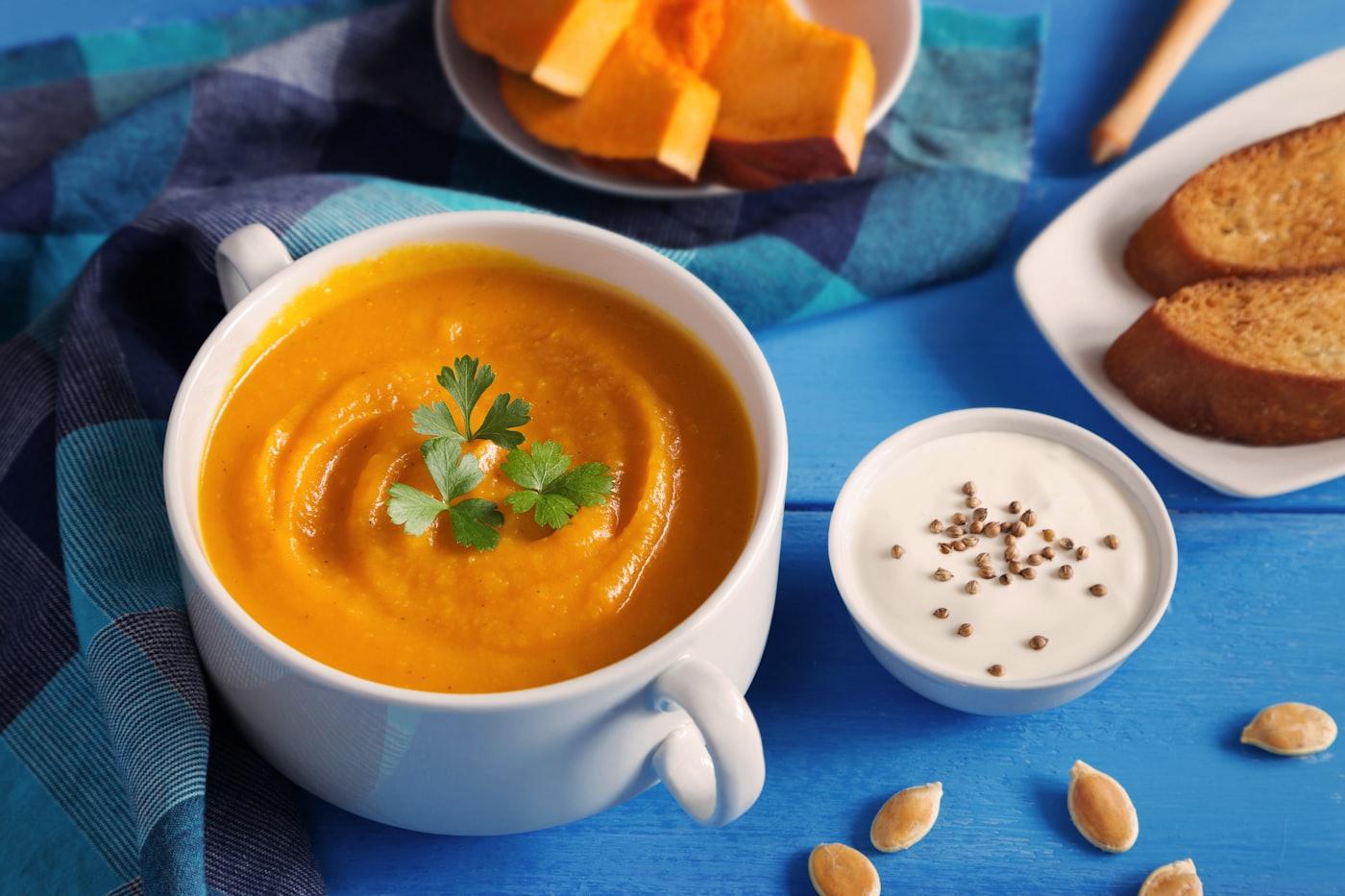
Pumpkin Soup is one of the best early-game recipes: it noticeably boosts defense and luck, and it's made from pumpkin and milk — two staple farm products. The recipe is gifted by Robin once you've become good enough friends, a small but charming touch.
In the real world, pumpkin soup is a classic of autumn cooking everywhere, from the French velouté to American Thanksgiving soup. The base is similar across the board: roasted or boiled pumpkin flesh, onion, stock, and cream or milk to make the texture velvety. A little nutmeg, ginger, or a scatter of pumpkin seeds on top, and a humble dish turns restaurant-worthy.
If you want to recreate the in-game version as close to canon as possible, we have a detailed step-by-step recipe — Stardew Valley Pumpkin Soup — with the milk ratios, the roasting temperature, and how to blend the puree perfectly smooth.
A few rules to make the soup thick and gently sweet, like autumn on the farm:
- Use dense pumpkin varieties (butternut or kabocha) — watery squash gives a thin flavor.
- Soften the onion first — that's your base of sweetness.
- Roast the pumpkin rather than boiling it: excess water cooks off and a caramel note appears.
- Add the milk or cream at the very end and don't boil it, or it will curdle.
Fried Egg and Omelet: the farmer's breakfast
Chickens are the first living creatures almost every player keeps, which makes eggs the earliest "homegrown" product. The game turns them into two dishes: the Fried Egg, the simplest recipe available practically from the start, and the Omelet, which needs an egg and milk.
The Omelet restores a solid chunk of health, and that honestly reflects reality: eggs are nearly perfect protein, and milk makes the mixture tender. A classic French omelet is cooked in butter over low heat, stirred constantly so it stays creamy inside with no browned crust. The American version, by contrast, is folded into a firm packet around a filling: cheese, vegetables, herbs.
The key to a tender omelet is simple — don't overcook it. Pull the pan off the heat while the top is still slightly wet; it will finish cooking on its own in half a minute. This is that very "farmer's breakfast before the mines": fast, filling, and made from two things you always have on hand.
Hashbrowns
Hashbrowns in the game are the crispy potato cakes familiar to anyone who's ordered an American breakfast. In Stardew Valley the recipe gives a modest farming buff and is made from potato and oil — once again, two simple farm products.
In real kitchens, hashbrowns are a staple of American diners: grated potato is squeezed dry and fried in a pan until it forms a crisp golden crust. Close relatives exist worldwide — the Swiss rösti and Eastern European potato pancakes are made almost the same way.
To get hashbrowns crispy rather than soggy:
- Squeeze the potato dry. After grating, wrap it in a towel and wring out the water — this is the crucial step.
- Use plenty of oil and don't fidget. Let the bottom set properly before flipping.
- Salt at the end. Salt draws out moisture, so add it to the finished dish.
A perfect partner for the omelet — and there's your complete farm breakfast straight out of Pelican Town.
Cookies and Salad: the sweet and the green
Cookies in the game are a sweet treat often given to neighbors to boost relationships, since nearly every villager loves them. They're made from wheat flour, sugar and egg — classic homemade dough. Real basic sugar or chocolate-chip cookies are made the same way: cream butter with sugar, add egg and flour, and chocolate chips if you like. The main thing is not to dry them out — take the tray out when the edges have set but the center still looks soft.
Salad is the opposite pole: a light spring dish of foraging. In the game's canon it's made from wild greens — dandelion, leek and violet, which the character finds in the forest in early spring. That's not fiction: young dandelion leaves and wild leek really are edible and have gone into country salads for centuries as the first greens after winter.
If you want to recreate the "wild" salad at home, you don't have to head into the woods: take arugula, baby spinach, green onion, and a couple of edible flowers (nasturtium, say) for the spirit of canon. Dress it with olive oil, lemon, and a pinch of salt. The result is light, fresh, and completely in the game's logic: eat what grew nearby, in season.
What to cook in real life: where to start
If you're just bringing the Stardew Valley kitchen to your own stove, the easiest approach is to assemble these dishes into one farmer's day:
- Morning — omelet with hashbrowns.
- Midday — a spring greens salad.
- Evening — pumpkin soup.
- For dessert and a gift to a neighbor — cookies.
All five recipes rest on a single idea: simple local produce, minimal processing, maximum comfort. That's exactly why people love Stardew Valley — it reminds us that good food doesn't need rare ingredients, only a little attention and whatever season is outside the window. Start with the soup, and pixel autumn will turn out tastier than you expected.