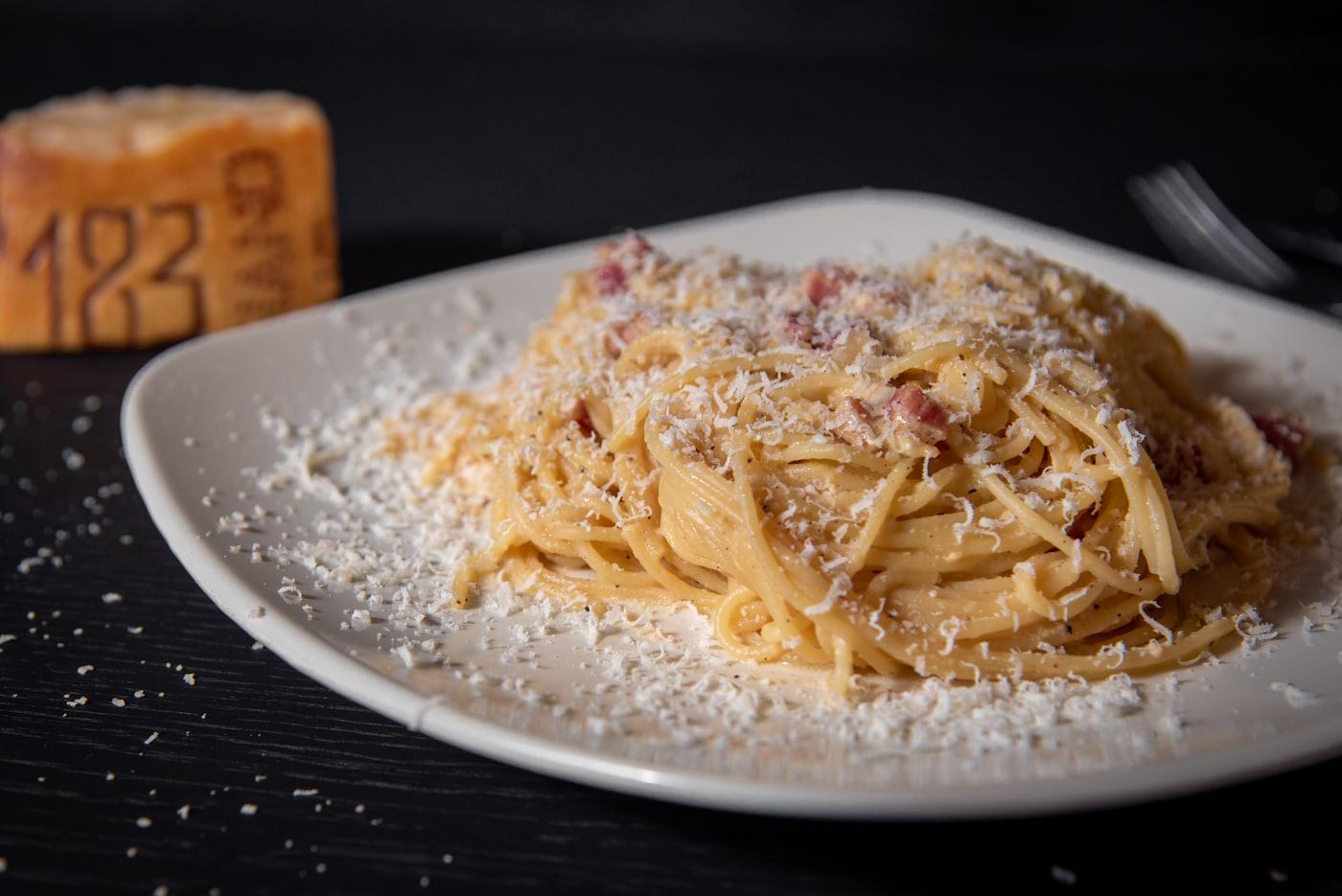
If you have ever ordered carbonara at a cafe and received a plate of pasta drowning in a thick white cream sauce with bits of bacon, we have bad news: that was not carbonara. Or at least, not the carbonara they make in Rome. The real dish does not contain a single drop of cream, and its silky texture comes from a completely different kind of magic.
Italians treat carbonara with almost religious devotion. The debate over whether you may add cream is, for them, roughly what the question of putting sugar in borscht is for us, only louder. And they have good reason: the classic recipe is not merely tradition but a precise technique in which each of the four ingredients plays a specific role.
In this article we will break down what carbonara is actually made of, why cream has no business being in it, where the dish came from in the first place, and how to achieve that perfect creaminess without scrambling your eggs. By the end, you will be fully ready to get cooking.
Four ingredients, and not one more
Classic Roman carbonara is a textbook example of the Italian philosophy of cucina povera, the cooking of the poor, where a minimum of simple products yields something extraordinary. The authentic recipe calls for just four ingredients in the sauce (pasta and salt aside):
- Guanciale — cured pork cheek. Not bacon, not pancetta, but guanciale specifically. It has a higher fat content and a richer, almost nutty flavor. As it cooks, the fat renders out and becomes the base of the sauce.
- Pecorino Romano — a hard, salty sheep's-milk cheese. It is sharper and saltier than Parmesan, and its bite is exactly what makes carbonara taste the way it does.
- Eggs — usually yolks, sometimes with one whole egg added. They create that signature creamy, coating sauce.
- Black pepper — freshly ground, and plenty of it. According to one theory, the black pepper resembling flecks of coal is what gave the dish its name (carbone is Italian for "coal").
That is the entire list. No onion, no garlic, no mushrooms, and most importantly, no cream. Anything else served to you under the name carbonara is already a loose interpretation.
Why cream is a mistake
Cream sneaks into carbonara for one mundane reason: it makes things easier. The egg sauce is temperamental and easy to overheat, at which point your tender cream turns into scrambled eggs with noodles. Cream, on the other hand, forgives almost any mistake: it is stable, it does not curdle, and it guarantees a smooth texture. That is why restaurants and ready-meal factories add it as insurance, and to cut costs.
But you pay for that convenience with flavor. Here is exactly what gets lost:
- Cream drowns out the cheese. The defining note of carbonara is the sharp, salty bite of Pecorino Romano. Fatty cream smooths that edge away, and the dish becomes bland, flat, almost nursery-food.
- The lightness disappears. A proper egg-and-cheese sauce tastes rich but never heavy. The cream version sits in your stomach like a brick.
- The identity is lost. Carbonara with cream does not become a tastier version of plain creamy pasta; it simply becomes plain creamy pasta. The very thing the dish exists for is gone.
The creaminess of real carbonara comes not from cream but from an emulsion of egg yolks, grated pecorino, and the starchy water the pasta was boiled in. Done right, this mixture coats every strand with a silky sauce that cream could never dream of.
Where carbonara came from
Surprisingly, carbonara is a relatively young dish. It does not appear in the classic Italian cookbooks of the early twentieth century: the first mentions date to the mid-1940s, and the recipe shows up in print around 1950.
Theories of origin
There is no single agreed-upon story, but several plausible versions exist:
- The charcoal makers (carbonari). The most romantic legend says the dish was made by the charcoal burners of the Apennines, a hearty, simple meal easy to cook in the field. Hence the name, from carbone, "coal."
- The American connection. Many food historians believe modern carbonara was born in Rome after the city's liberation in 1944, when locals gained access to American army rations of powdered eggs and bacon. Italian cooks reinterpreted these ingredients in their own way.
- An urban invention. Another version holds that the dish simply evolved from the Roman pasta cacio e pepe (cheese and pepper), with egg and guanciale added.
The truth probably lies somewhere at the intersection of these stories. What matters is this: from the very beginning, the recipe contained no cream. That is a later distortion that took root mainly outside Italy.
How to get creaminess without cream
The beginner's greatest fear is that the eggs will scramble. It does happen, but it is easy to avoid once you understand the principle: the egg sauce must be cooked by residual heat, not over a flame.
Here are the key rules:
- Take the pan off the heat. Before combining the pasta with the egg mixture, remove the pan with the guanciale from the stove and let it cool slightly. Direct heat is the enemy.
- Use the pasta water. That starchy, salted cooking water is the secret ingredient. A couple of spoonfuls help the yolks and cheese form a smooth emulsion and let you adjust the thickness of the sauce.
- Mix the eggs with cheese in advance. Whisk the yolks with grated pecorino and a generous amount of pepper in a separate bowl until paste-like. This spreads the cheese evenly and keeps it from clumping.
- Work fast and constantly. Add the hot pasta to the pan, pour in the egg mixture, and stir vigorously. Gradually add pasta water until the sauce turns glossy and clinging.
If you do everything right, you will end up with a silky sauce that holds onto the pasta rather than pooling on the plate. No cream required, just technique and a little nerve.
Common mistakes
Even knowing the right ingredients, it is easy to trip up on the details. The most frequent slips:
- Cream. The big one we have already covered. Just do not add it.
- Overheated eggs. Sauce poured into a scorching pan will curdle. Take it off the heat.
- Bacon instead of guanciale. If you cannot find guanciale, the best substitute is pancetta, or unsmoked cured pork belly at a pinch. Smoked bacon will give you the wrong flavor.
- Parmesan instead of pecorino. Parmesan is milder and sweeter; with it the dish loses its trademark sharpness. At least part of the cheese should be Pecorino Romano.
- Onion and garlic. They are not in the classic recipe and only overwhelm the dish's delicate balance.
- Draining all the water. Do not pour off the pasta water before you have made the sauce, or the emulsion will not come together.
Conclusion
Carbonara is a beautiful example of how simplicity demands skill. Four ingredients, no cream, precise technique, and the result is one of the most beloved dishes in world cuisine. Make the real version once and the creamy imitations will stop seeming edible.
Now that you know the theory, it is time to put it into practice. Have a look at our detailed Pasta Carbonara recipe, with exact proportions and step-by-step instructions, and cook it the way they do in Rome.