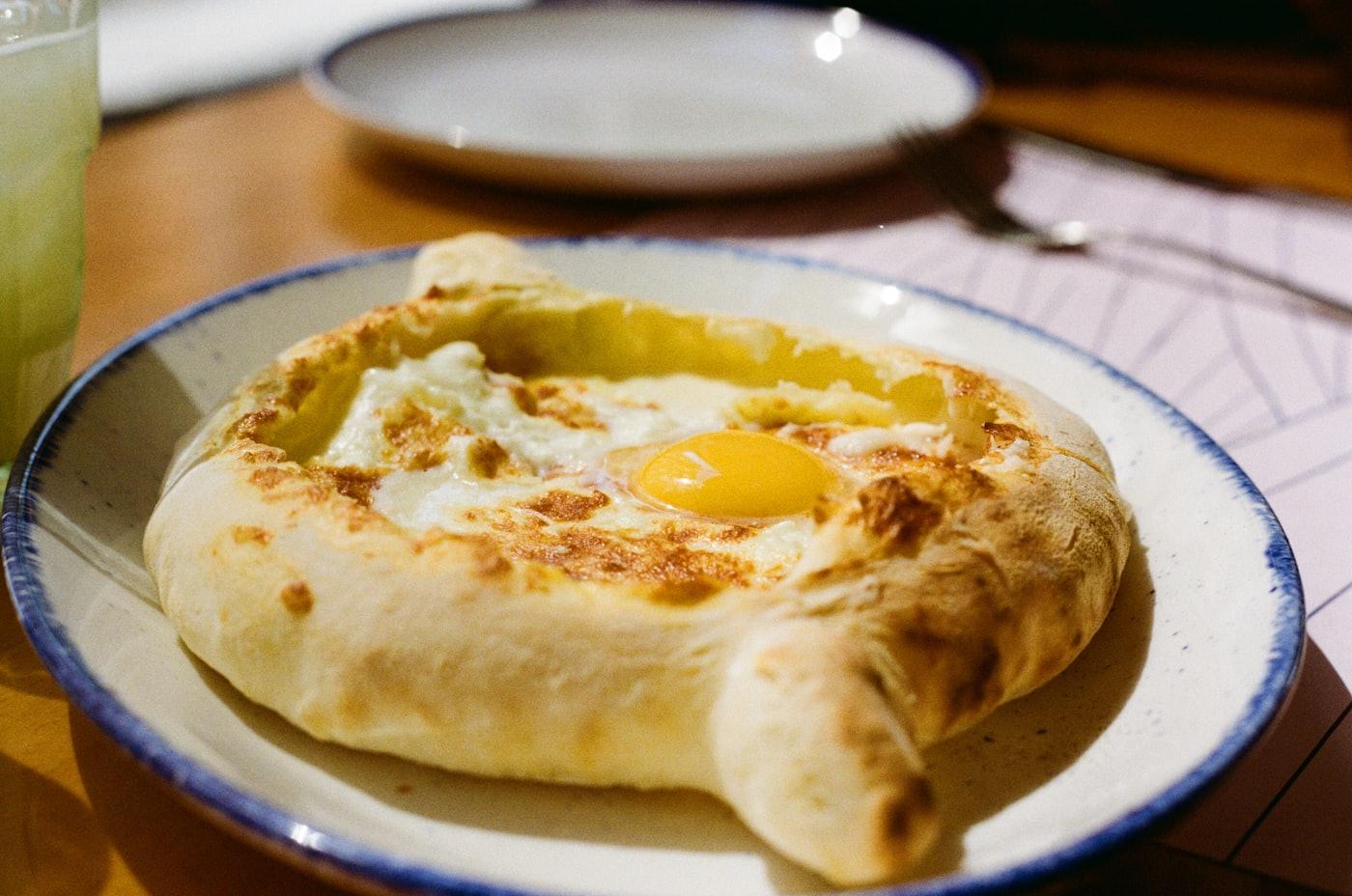
Picture a golden boat of dough brimming with a lake of stretchy melted cheese, and right in the middle a glossy egg yolk like a sun over the sea. This is Adjarian khachapuri: arguably the most recognizable and photogenic dish in all of Georgian cuisine. In English it often goes by a fitting nickname — the Georgian cheese boat.
Khachapuri as a whole is a family of Georgian cheese breads, and every region has its own signature version. The Imeretian style is round and sealed; the Megrelian has cheese both inside and on top. But it is the open Adjarian boat, crowned with an egg, that became the calling card of the entire country and the star of countless food photos.
In this article we will unpack where that famous shape comes from, which cheeses make the filling right, why a raw egg and a knob of butter go on top, and — most importantly — how to actually eat the thing without burning yourself or freezing up over your plate.
Where the boat comes from
The dish hails from Adjara, a coastal region in southwestern Georgia with its capital in Batumi. This is a subtropical corner on the shore of the Black Sea, and the local cooking soaked up both Black Sea and Turkish influences: neighboring Turkey lies just a few dozen kilometers away.
Khachapuri as a concept has been known in Georgia for centuries — the word itself combines "khacho" (curd, cheese) and "puri" (bread), so it literally means "cheese bread." The open boat shape with an egg, however, is a relatively late Adjarian invention that spread across the country in the 20th century and came to be seen as a symbol of Georgian food as a whole.
You will find it in every seaside cafe in Batumi, and for many travelers the first taste of Georgian cuisine is exactly this: a piping-hot cheese boat alongside a glass of homemade wine.
The symbolism: sea and sun
The loveliest story about Adjarian khachapuri concerns its shape. The elongated dough boat is said to evoke the Adjarian fishing boats that put out into the Black Sea. The molten cheese inside is the sea itself, and the yolk in the center is the sun, reflected on the water or setting beyond the horizon.
It is best to treat this as a charming folk reading rather than a documented historical fact — there is no record of an "original intent." But the image is so precise and poetic that it stuck for good, and it genuinely helps you understand the dish. When you swirl the yolk and butter into the hot cheese, it is easy to believe you are looking at a tiny edible sea at sunset.
That symbolism is exactly the hook that lodges in your memory. It is a big part of why Adjarian khachapuri is loved both in Georgia and far beyond its borders.
The cheeses: sulguni and Imeretian
The heart of the dish is cheese, and not just any cheese — specific Georgian varieties matter here.
- Imeretian cheese is a young brined cheese, soft and slightly tangy, which melts beautifully and gives that tender texture. It is the base of the filling.
- Sulguni is a denser, stretchier brined cheese that pulls into strings when heated. It is responsible for the signature chewy stretch that the whole dish is built around.
The classic filling is a roughly equal blend of the two: Imeretian brings softness and creaminess, sulguni brings stretch and a slightly salty accent. Both are brined cheeses, so the filling is fairly salty on its own — you usually do not need to add salt.
Substitutes outside Georgia
Finding the real Georgian cheeses outside the region can be tricky. These swaps give a similar result:
- Low-moisture mozzarella (the pizza kind) — for stretch in place of sulguni.
- Feta or brined cheese — for the salty, briny character in place of Imeretian, though you may want to soak it to draw out excess salt.
- Soft farmer-style brined cheese — a close cousin and a solid base.
The goal is balance: part of the cheese should be stretchy and meltable, part soft and salty. Some cooks fold in a little curd or quark to round out the flavor.
The egg and butter: the final touch
What turns a plain cheese boat into Adjarian khachapuri happens at the very end. The finished, already golden boat full of melted cheese comes out of the oven, and a raw egg is gently slipped into the center — often whole, sometimes just the yolk. A knob of butter goes on top right away.
The hot cheese and dough walls bring the egg to just the right state: the white sets slightly while the yolk stays runny, like a warm custard sauce. The butter melts and enriches the filling. No extra cooking of the egg is needed — all the magic is in the residual heat.
This is exactly why Adjarian khachapuri is served immediately, straight from the oven: the dish is meant to finish coming together right on your plate.
How to eat it properly
Many people freeze up in front of the steaming boat, but the ritual is simple and pleasant.
- Give the boat a minute to cool slightly — the cheese under the crust is scorching.
- Using a fork and knife, stir the yolk, butter, and cheese together right inside the boat until they turn into a smooth, stretchy pool. The yolk enriches the sauce and binds everything.
- Tear pieces from the rim — the boat's pointed "prows" are made crisp on purpose so you can hold them by hand.
- Dip the bread into the cheese-and-egg mixture and eat. The boat is both the dish and its edible vessel at once.
Adjarian khachapuri is usually eaten with your hands, or a mix of cutlery and fingers — there is no strict etiquette. Traditionally it is washed down with homemade wine, tan (a fermented yogurt drink), or simply water. It is a hearty dish: one large boat easily stands in for a full lunch.
If you want to try building this boat yourself, we have a detailed step-by-step recipe for Adjarian Khachapuri — with yeasted dough, the right cheese blend, and that signature egg on top.
Conclusion
Adjarian khachapuri is a rare case where a dish works equally well as simple, satisfying food and as a small story. The boat-sea-sun image, stretchy sulguni with soft Imeretian, the runny yolk and melting butter — it all adds up to one of the most charming culinary images Georgia has to offer.
The good news is that recreating it at home is entirely doable: you just need the right cheeses (or sensible substitutes), an easy dough, and a couple of minutes for the final assembly. Head over to Adjarian Khachapuri and make your own boat — with your own little edible sea and a sunset-yolk in the center.