Georgian food is easy to fall in love with from the very first dish. There are almost no half-measures here: the cheese stretches in long threads, the spices speak at full volume, and the wine flows as if every dinner were a small celebration. And that is not an exaggeration — a celebration at the Georgian table really is almost always happening, and it even has a name: the supra.
Geography did half the cook's work here. Georgia sits between the Black Sea and the Caucasus Mountains, at the crossroads between Europe and Asia, and every one of its provinces — from subtropical Adjara to the mountainous Khevsureti — has thrown something of its own into the shared pot. That is where the variety comes from: khachapuri alone is made differently in every region.
This guide is for anyone just getting to know Georgian food. We will walk through the key dishes, learn how adjika differs from a sauce, peek behind the scenes of the Georgian feast, and finish at the most logical starting point for any home cook — khachapuri.
Khachapuri: the cheese bread that became a symbol
If Georgian cuisine has a face, it is khachapuri — a cheese-filled bread with dozens of regional versions. The word is literally made of two parts: "khacho" (curd, cheese) and "puri" (bread). Simply put, cheese bread — but behind that simplicity lies a whole map of the country.
The best-known kinds:
- Imeretian — a round, closed flatbread filled with imeruli cheese; the most basic and widespread version.
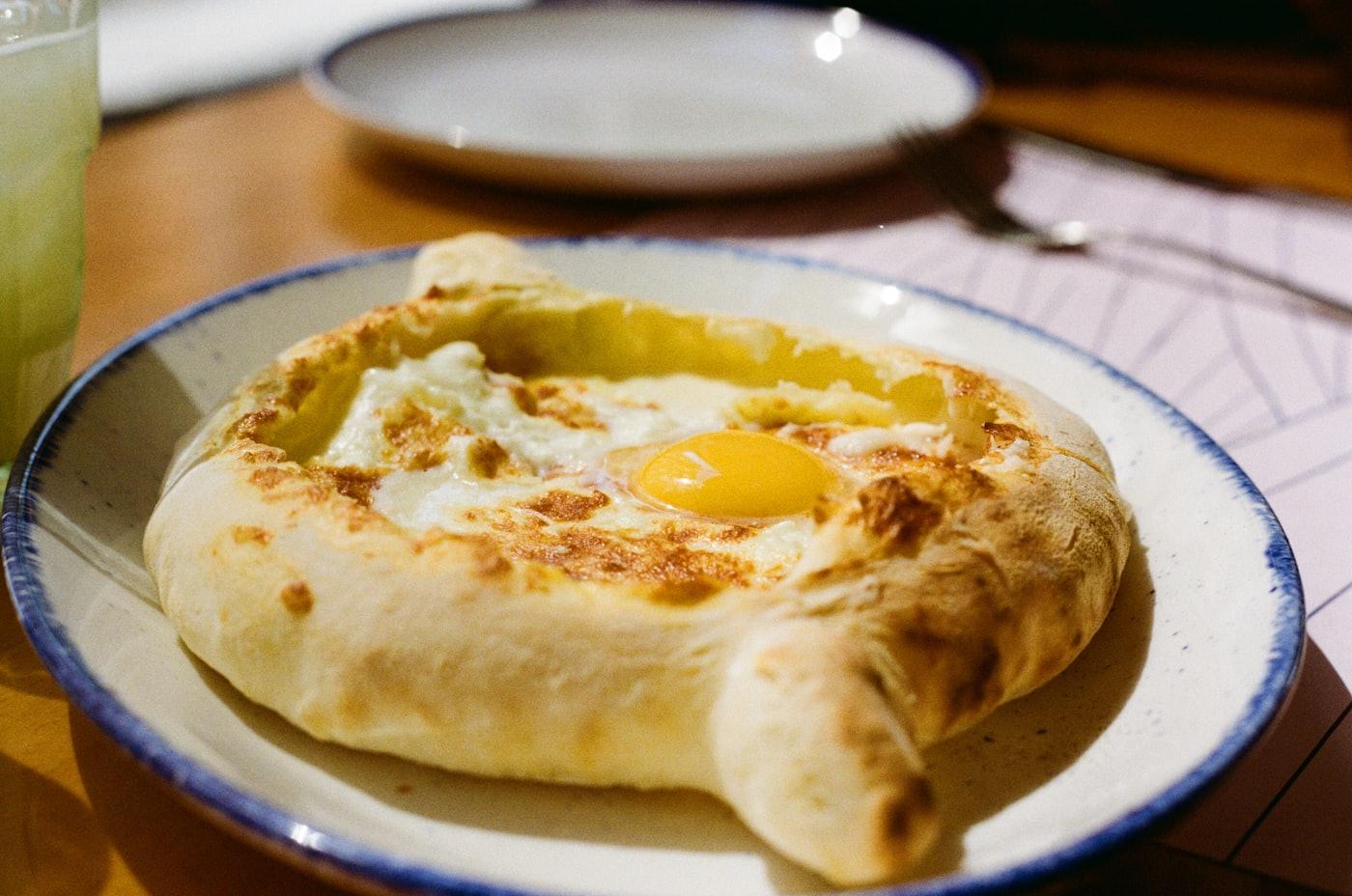
- Adjarian — an open boat of dough filled with cheese, topped with an egg and a knob of butter. The shape is no accident: it is said to resemble a boat with the yolk as the sun, a nod to coastal Adjara.
- Megrelian — like the Imeretian, but with cheese sprinkled on top as well, so the crust turns out especially golden.
- Achma — a layered version made from boiled sheets of dough, closer to a savory bake.
The Adjarian version is the easiest place to begin at home: the dough is shaped by hand, the filling is generous and straightforward, and the final gesture — swirling the hot yolk into the cheese right in the boat — turns cooking into a small ritual. We have put together a detailed recipe separately: Adjarian Khachapuri.
Khinkali: the art of the pleat
Khinkali are juicy meat dumplings, distant cousins of pelmeni and manti but with a character all their own. They come from the mountain regions of eastern Georgia — Pshavi, Mtiuleti, Khevsureti — where hearty food was a matter of survival in a cold climate.
The classic filling is hand-chopped (not ground) beef with pork, plenty of herbs, onion and spices. The real trick is that there is broth inside the khinkali: as they cook, the meat's juices gather within the dough. That is why you eat them strictly by hand and by the rules — grab the "tail" (the twisted knot on top), bite carefully from the side, sip out the broth, and only then finish the rest. The thick knot, by the way, is usually left uneaten: people once counted it to see how many khinkali a guest had managed.
A good khinkali is recognized by its number of pleats — masters fold eighteen, twenty or more. At that point it is no longer just food but a small craft.
Lobio, satsivi, chakhokhbili: the warmth of everyday cooking
The festive table is wonderful, but the real heart of a cuisine lives in its everyday dishes. And here Georgians have plenty to offer.
Lobio is a bean dish, one of the most democratic and beloved. It is made in different ways: stewed with onion, cilantro and spices, or mashed into a thick paste. Lobio is often served in a clay pot with mchadi (cornbread) and pickled vegetables. It is filling, fragrant and completely meat-free — the beans are the star here.
Satsivi is a festive dish from western Georgia: chicken or turkey under a thick walnut sauce with garlic, spices and the indispensable khmeli-suneli blend. It is served cold, traditionally as part of the New Year's table. Walnuts appear almost everywhere in Georgian cooking, and satsivi is their most ceremonial expression.
Chakhokhbili is a poultry stew (the name comes from an old word for pheasant, though chicken is more common today). The meat is braised with a generous amount of tomatoes, onion and fresh herbs until the sauce turns thick and rich. This is a home dish in the warmest sense of the word — the kind you make when you want to feed the people you love.
Adjika and the Georgian spice cabinet
Much of the flavor of Georgian cuisine rests on its seasonings and sauces. They are bright, aromatic and often fiery.
The leading lady is adjika. Contrary to popular belief, real adjika is not a tomato sauce but a thick paste of hot red pepper, garlic, salt and aromatic herbs. It originated in Abkhazia and the neighboring regions; red and green adjika differ in the peppers and herbs used. It is used sparingly — as a concentrate of flavor.
Alongside it are other essentials:
- Khmeli-suneli — a dry spice blend (coriander, blue fenugreek, savory, dill and more), Georgia's answer to an all-purpose seasoning.
- Tkemali — a sour, tangy sauce made from wild plums, the perfect partner for meat.
- Svan salt — fragrant salt with herbs and garlic from mountainous Svaneti.
- Cilantro, tarragon and basil — fresh herbs here are not a garnish but a full-fledged ingredient.
It is precisely these accents that make a Georgian dish recognizable from the very first spoonful.
Wine, the supra and the tamada
Georgia is rightly called one of the cradles of winemaking: archaeologists have found traces of wine production on this land dating back roughly eight thousand years. The local technique — fermentation in clay vessels called qvevri buried in the ground — is inscribed on UNESCO's intangible heritage list. So wine here is not a drink to go with dinner but part of the cultural code.
And this culture reveals itself best at the supra, the traditional feast. A supra may be celebratory (a wedding feast, for example) or simply a gathering of friends, but in every case it is not a chaotic dinner — it is a feast with its own rules.
The supra is led by the tamada, the toastmaster, a kind of conductor of the table. He delivers long, carefully crafted toasts in a set order: to peace, to the homeland, to parents, to those who have passed, to love, to the guests. A good tamada is poet and psychologist at once, and to be one is a great honor. A guest at a Georgian table is always the center of attention, and to feed them beyond all measure is considered a sacred duty.
Where to begin at home
Georgian cuisine may look vast, but stepping into it is easier than it seems. Here is a sensible order for a beginner:
- Start with Adjarian khachapuri — it is impressive, forgives small mistakes, and immediately shows you why this cuisine is so loved.
- Get comfortable with the basic seasonings — buy some khmeli-suneli and try making a simple adjika.
- Move on to lobio and chakhokhbili — everyday dishes that are easy to repeat and adapt to your taste.
- When you want a challenge, take on khinkali with their pleats and the broth hidden inside.
The main thing Georgian cuisine teaches is generosity. Here you do not skimp on cheese, herbs or hospitality. So call your loved ones, put something bright on the table and begin — with a boat of molten cheese, for instance. Ready to try? Here is the step-by-step recipe: Adjarian Khachapuri.