If you've ever watched a Studio Ghibli film, you probably remember more than the flying castles and forest spirits — you remember the food. A steaming bowl of ramen. A fat rice ball pressed into the hands of someone in tears. Bacon sizzling in a pan. In the worlds of Hayao Miyazaki and his colleagues, food is never just set dressing. It's an act of care, a moment of calm, a quiet promise that life goes on after the trials are over.
This love of food in Ghibli's work runs so deep that it has its own nickname — "Ghibli food" — and fans around the world recreate dishes from their favorite scenes. The good news: almost all of it is real. Behind the hand-drawn frames are genuine Japanese dishes — onigiri, bento, ramen — that are surprisingly easy to make at home.
Let's walk through the most beloved culinary moments in the Ghibli universe, sort out what's actually shown on screen versus what's a charming bit of animator's license, and learn to cook this food for real.
Why Miyazaki's food scenes hit so hard
The secret is that Miyazaki doesn't draw food — he draws the feeling of food. Ghibli animation is famous for its attention to movement and texture: the stretch of melted cheese, the rising steam, the wobble of a yolk about to burst. People call it "food porn" in animation, but it's about more than looking delicious.
In Ghibli films, food almost always appears at an emotionally charged moment. A character is exhausted, lost, frightened — and someone gives them something to eat. It's one of the oldest human gestures: to feed someone is to care for them, to accept them, to say "you are not alone." That's why a plain rice ball can move you to tears more than any battle scene.
There's a cultural layer too. The Japanese ritual of itadakimasu — a word of gratitude said before eating — and the idea of gohan (cooked rice as a stand-in for the whole meal, and for home itself) run through these scenes. Miyazaki shows simple, honest, homemade food, and that very simplicity is the source of its power.
Onigiri from Spirited Away
It's one of the most famous food scenes in all of anime: Chihiro, drained and afraid, sits on a flight of steps, and Haku hands her an onigiri — a rice ball. She holds herself together as long as she can, and then, after the first bite, she breaks down and cries. It's a perfect illustration of how food can say "everything will be okay" without a single extra word.
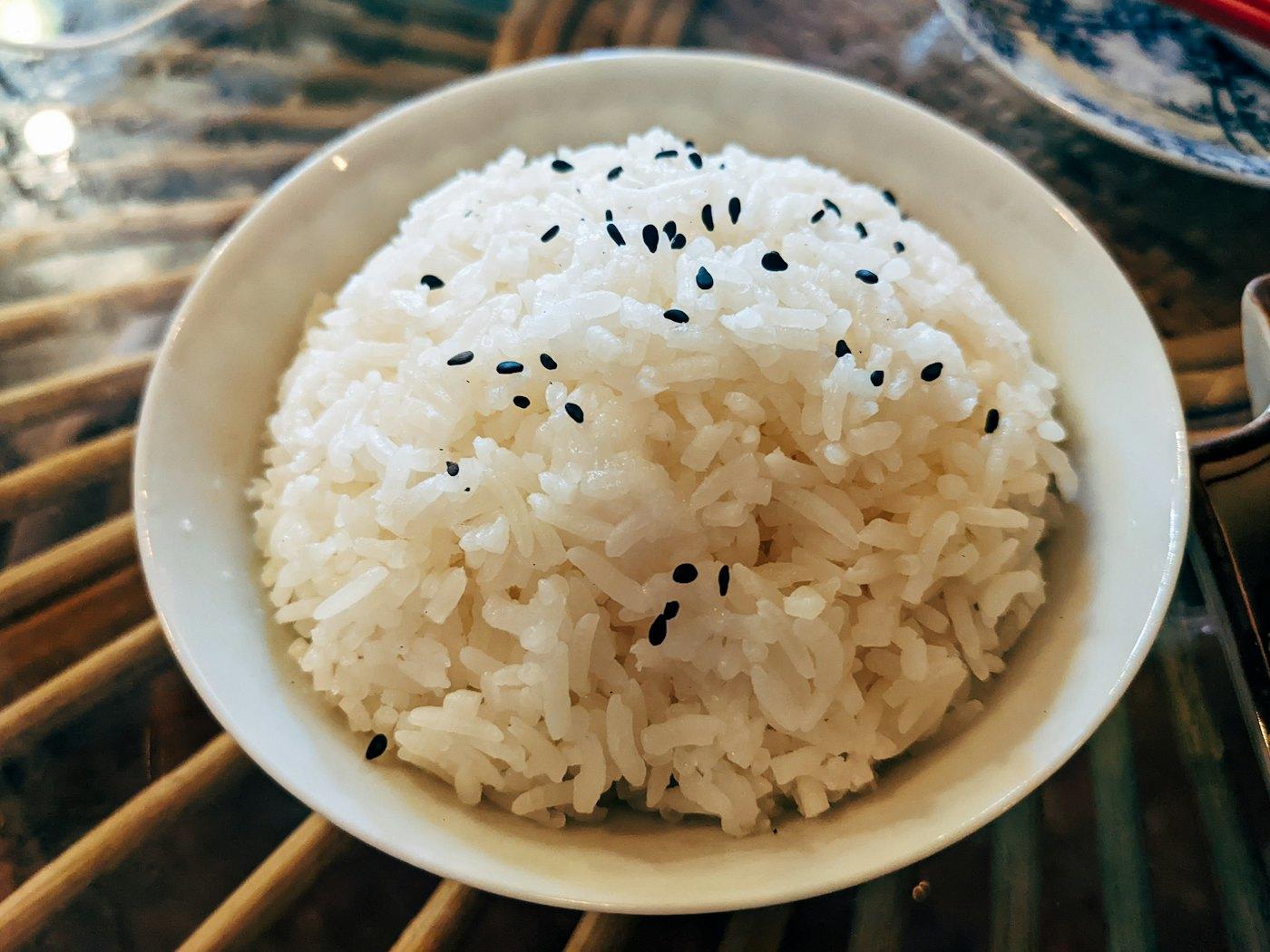
Onigiri is a completely real and very old Japanese dish. It's pressed rice, usually shaped into a triangle, often with a filling inside and a strip of nori (dried seaweed) wrapped around the outside. References to rice balls appear in Japan as far back as the Heian period (794–1185), and as travel food onigiri have been around for centuries. People carried them into the fields, on journeys, and even into battle, because rice keeps well and is easy to eat by hand.
Classic fillings include umeboshi (salty pickled plum), a piece of grilled salmon, tuna with mayonnaise, or seasoned pollock roe. But the real magic of onigiri is its simplicity: sometimes it's just rice with a pinch of salt.
If you want to recreate that exact scene, we have a step-by-step guide — the Onigiri from Spirited Away. A few tips to make it look like the film:
- Use Japanese short-grain rice — only this kind gets sticky enough to hold its shape.
- Shape the ball with slightly wet hands dusted with salt, so the rice won't stick and gets seasoned at the same time.
- Don't press too hard: an onigiri should keep some air inside so it stays soft rather than dense and heavy.
- Add the nori just before serving so it stays crisp.
Bacon and eggs from Howl's Moving Castle
Another iconic scene is the breakfast in Howl's Moving Castle. Calcifer, the fire demon, reluctantly becomes a stove, and over his flames thick-cut bacon and eggs sizzle away. The hiss, the spitting fat, the golden yolks — that single frame made millions of viewers crave the exact same breakfast.
Here everything is entirely real: it's plain bacon and eggs, an English breakfast in its simplest form. There's nothing fictional about it — except, of course, the talking stove. The charm of the scene is in the contrast: a magical world, a living flame, a walking castle — and yet the most down-to-earth, homely breakfast imaginable.
To recreate the "castle breakfast":
- Use thick-cut bacon — those chunky slices are what give the look from the film.
- Lay the bacon in a cold pan and heat it slowly, so the fat renders out and the slices turn crisp without drying out.
- Crack the eggs into the rendered fat and keep the yolks runny, just like in the frame.
- Serve at once, with a slice of bread. In the film everyone eats together at one table — that's part of the pleasure.
Bento and lunch from My Neighbor Totoro
My Neighbor Totoro has a quiet, very Japanese moment: the father makes lunch boxes — bento — for the girls, and Mei and Satsuki carry them off in their little containers. You can see the rice, an umeboshi in the center (that "red sun on white" is a nod to the Japanese flag, and this style is called hinomaru bento), and pickled vegetables. Later, the grandmother treats the girls to fresh produce straight from the garden.
Bento is a genuine, complete format for a Japanese packed lunch in a divided box. The tradition goes back to the Kamakura period (12th–14th centuries), when dried rice was carried for the road. A modern bento is all about balance: rice, a protein (fish, meat or egg), vegetables, and something pickled. Japanese cooks treat the assembly of a bento almost as an art form, paying attention to color and the balance of flavors.
The core lesson of Totoro is food as an expression of a parent's love. The father cooks himself, carefully, and that says more about the family than any line of dialogue. If you want to build your own "Satsuki bento," aim for simplicity: white rice, a red umeboshi in the center, a little greenery and something salty. You don't need elaborate shapes — the bento in the film is plain and honest.
Ham and noodles from Ponyo
Perhaps the most meme-worthy Ghibli dish of all is the ramen in Ponyo. Lisa, the mother, pours boiling water over instant noodles, puts the lid on, and while everyone waits, Ponyo practically bounces with impatience. When the lid comes off, there are noodles in broth crowned with halves of a boiled egg and big slices of pink ham. Ponyo falls in love with that ham almost as hard as she falls for Sosuke.
Honestly, this is the simplest "recipe" on the list: it's instant noodles (cup or packet ramen) dressed up with toppings. And there's truth in that — Japanese instant ramen was invented by Momofuku Ando in 1958 and became a symbol of quick, comforting home food. The scene shows how a little effort can turn something humble into a celebration.
To recreate "Ponyo's ramen," take any instant noodles and add on top:
- Halves of a boiled egg (for accuracy, plain hard-boiled, though an ajitama — marinated egg with a jammy yolk — tastes even better).
- Thick slices of cooked pink ham — it's the star of the scene.
- Optionally, some green onion for freshness.
This is a perfect dish to make with kids: the magic isn't in the difficulty but in the anticipation, in that very minute of waiting under the lid.
How to make a "Ghibli meal" at home
If you want to put together a whole themed meal in the spirit of the studio, here's a simple plan with no rare ingredients:
- Start with rice. Cook Japanese short-grain rice and make a few onigiri. It's the heart of nearly every Ghibli meal.
- Add a protein. Fry thick bacon and eggs "the Calcifer way," or boil eggs for the ramen.
- Add something pickled. Umeboshi or pickled cucumbers bring that Japanese note and a touch of acidity.
- Finish with noodles. Brew some ramen and top it with ham and egg in honor of Ponyo.
The main thing is not to chase the perfect picture. Ghibli's magic isn't in expensive ingredients — it's in food cooked and shared together, with warmth.
Conclusion
Food in the Ghibli universe works because it's real — not only visually, but at heart. Behind every frame is a clear human gesture: feeding the weary, delighting a child, gathering a family around one table. Onigiri, bento, bacon and eggs, ramen — these are simple dishes any of us can make, and that's exactly where their power lies.
Try starting with the most famous one — the Onigiri from Spirited Away. After that it's up to you: add Calcifer's bacon, pack a bento like the caring father in Totoro, or brew ham-topped ramen like Ponyo's mom. And when you sit down to eat, don't forget to say itadakimasu.