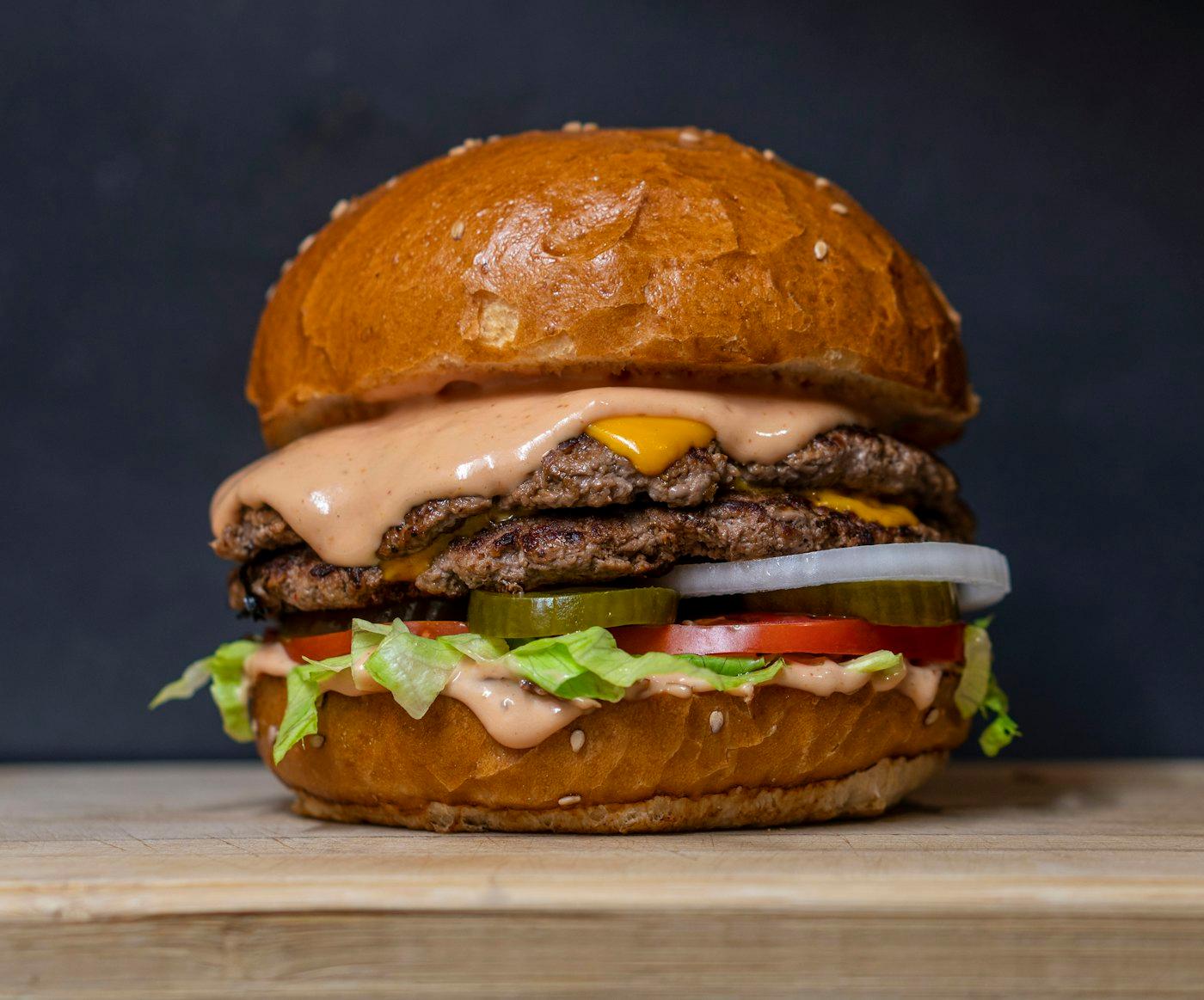
American cuisine rarely claims to be refined, and that is precisely its strength. It is the food of immigrants, roadside diners and big family Sundays — food you want to eat with your hands, share at a crowded table and remember years later. Behind the phrase "comfort food" hides an entire philosophy: dishes that warm not the stomach but the memory.
Assembled from dozens of immigrant traditions, the country melted German chopped patties, Irish potatoes, Italian cheese and African smoking techniques into something new and instantly recognizable. The burger, barbecue, macaroni and cheese, the donut and the cheesecake are the five pillars holding up the gastronomic self-portrait of the United States.
American pop culture also gave the world what is probably the most famous imaginary burger of all time. We will get to it at the very end — but it is exactly that burger which best explains why this dish became not just food, but a symbol.
The Burger: A Chopped Patty That Conquered the Planet
The story of the hamburger begins in the German city of Hamburg, from which 19th-century emigrants brought the "Hamburg steak" — a chopped beef patty — to the United States. On American soil it was quickly tucked between two halves of a bun so it could be eaten on the go, and the format we know today was born.
Who did it first is a matter of eternal debate. Contenders for the title of inventor include Louis' Lunch in New Haven (1900s), the fairground vendor Fletcher Davis of Texas and the Menches brothers of Ohio. The exact date is impossible to pin down, and it is more honest to admit that than to pass off one legend as fact.
What is beyond dispute is something else: in the 20th century the burger became an industry. White Castle standardized its small square patties in 1921, and McDonald's, after 1948, refined assembly to conveyor-belt precision. The classic American burger follows a clear formula:
- a beef patty with around 20% fat content for juiciness;
- a soft brioche or potato bun, lightly toasted on the inside;
- processed or cheddar cheese for a cheeseburger;
- a leaf of lettuce, a slice of tomato, pickles and onion;
- sauces — ketchup, mustard, mayonnaise or a signature "special sauce."
The secret of a good burger is not exotic ingredients but balance and temperature: a hot patty, slightly melted cheese, cool vegetables and a bun that holds it all together.
Barbecue: Smoke, Time and Patience
If the burger is about speed, barbecue is about the exact opposite. True American BBQ (not to be confused with a backyard grill) is the slow cooking of large cuts of meat in smoke at low temperature, sometimes for 12 to 16 hours. The technique traces its roots to the indigenous peoples of the Caribbean and the American South and to African American culinary traditions.
There is no single American barbecue — there are regional schools, and they argue more fiercely than rival sports fans:
- Texas — beef brisket, rubbed with a simple mix of salt and black pepper;
- The Carolinas — pulled pork with a vinegar- or mustard-based sauce;
- Kansas City — ribs under a thick, sweet, tomato-based sauce;
- Memphis — "dry" ribs with a spice rub and no sauce.
One thing unites them: hardwood smoke (hickory, oak, mesquite) and respect for time. Barbecue is weekend food, an excuse to gather in the yard with nowhere to rush off to.
Mac and Cheese: Coziness in a Single Pot
Macaroni and cheese is the very definition of the word "comfort" for millions of Americans. The dish arrived from Europe: recipes for baked pasta with cheese appeared in Italian and English cookbooks long ago, and in America it was popularized — so the legend goes — by Thomas Jefferson, who brought his love of pasta home from France.
Classic mac and cheese is macaroni in a béchamel sauce enriched with grated cheddar, sometimes baked with a crunchy breadcrumb crust. In the 20th century Kraft released a boxed version for 19 cents, and during the Great Depression it became a lifeline for families on a budget. Ever since, the dish has had two faces: the homemade baked version and the quick one from a box — and both are loved in their own way.
Donuts and Cheesecake: The American Dessert
The sweet side of the American table is also gathered from around the world. The donut in its ring shape was cemented by Dutch settlers and their olykoeks — "oil cakes." The hole in the center, by popular account, appeared so the dough would fry evenly. Today the glazed donut is a symbol of coffee breaks and of the police stereotypes lifted straight from the movies.
Americans made the cheesecake their own too, though its prototypes were known in Ancient Greece. The decisive version was the New York one: dense, creamy, built on Philadelphia cream cheese, invented in 1872. New York cheesecake — unfussy, with a shortbread or cracker base — became the benchmark copied all over the world.
You could add apple pie, brownies and chocolate-chip cookies to this company — all of them work on the same principle: simple ingredients, generous portions, zero pretense to sophistication.
The Birth of Fast Food
Comfort food and fast food in America grew from the same soil — the mass-market automobile. As the country took to cars in the 1920s through the 1950s, roadside diners, drive-in windows and chains with a single nationwide menu became the logical answer to a new way of life. Food had to be fast, cheap, recognizable in any state and edible with one hand behind the wheel.
That is when the familiar set came together: burger, fries, soda and a milkshake. Fast food is criticized for harming health — and rightly so — but as a cultural phenomenon it is inseparable from the image of 20th-century America. It is worth keeping the line in mind between culinary heritage and a daily diet: comfort food is best as a treat, not as the foundation of how you eat.
The Krabby Patty: The Burger That Doesn't Exist
And so we arrive at the most famous burger no one has ever truly tasted. The Krabby Patty from the cartoon "SpongeBob SquarePants" is the signature dish of the Krusty Krab, the diner around which half the plot revolves. Its recipe is the show's central mystery: the owner, Mr. Krabs, guards the "secret formula" that his rival Plankton spends years trying — and failing — to steal.
Let's be honest: within the canon the exact composition of the Krabby Patty is never revealed — that is a deliberate running joke. So any "real" version is a loving fan reconstruction, not an authentic recipe. Still, adapting the idea for an earthly kitchen is fun and easy: a patty based on crab meat or beef, a soft bun, fresh vegetables and a bright, seaside-diner sauce. We break down how to build such a burger at home in the recipe for the Krabby Patty from SpongeBob — with an honest note about what is from the cartoon and what we invented ourselves.
This fictional burger is a perfect metaphor for all of American cuisine. A piece of meat in a bun makes no claim to greatness on its own. What makes it great is context: the place, the company, the story and that elusive feeling of comfort we keep coming back to comfort food for, again and again.
Conclusion
American cuisine is not about complex techniques and rare ingredients. It is about generosity, accessibility and emotion. The burger teaches balance, barbecue teaches patience, mac and cheese teaches simplicity, and the desserts teach abundance. And the fictional Krabby Patty reminds us that food lives not only on the plate but in the stories we tell around it. Start with a favorite dish, add good company — and you will understand what real comfort food is all about.